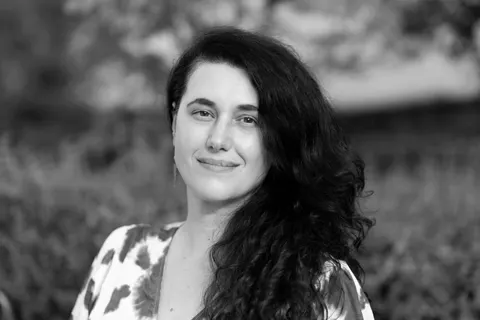
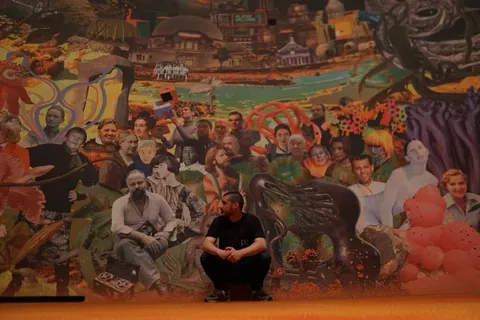
Today’s guest will never have artificial intelligence for competition. Because he is not only a virtuoso of words but also a mind so unconventional that there is no way to imitate it. Read his novel Korabat na sirenite (The Ship of the Sirens), experience one of his many plays, and you will see for yourself.
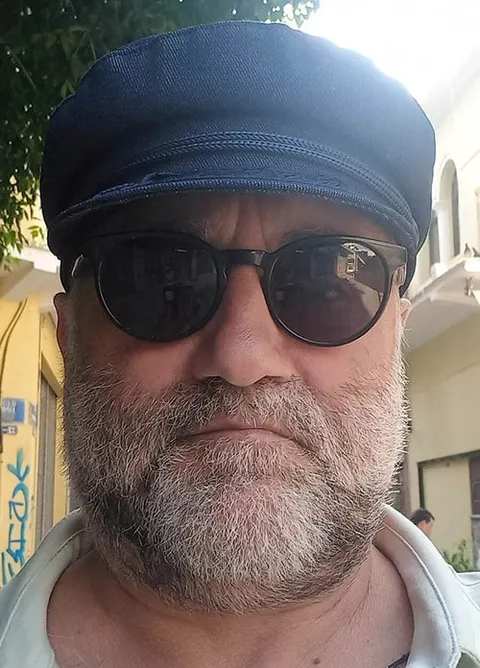
Alexander Sekulov is a playwright, poet and prose writer, translated and award-winning. A journalist with vast experience and… the founder of two music clubs in Plovdiv. An author beyond all clichés.
We will talk about words as a weapon. About “the violent deformation of public attitudes and the unspoken civil war we keep waging.”
About revolutions in digital times. About human development in the technological world and spiritual laziness. About intelligent humor and the edge of literary propriety. About carbon emissions and information emissions. Meaningful words on important subjects, worth reading carefully…
– Do you think humans are evolving? And is technology helping?
– The physical human body lives ever more comfortably and ever longer. If we take a Eurocentric view, we find that the blessings of high civilizational and technological development lead to demographic collapse. Broadly speaking, there are ever richer and healthier nations that are disappearing. It turns out that
contentment, satiety—even more broadly, having—leads to your not being.
You become so self-satisfied and self-sufficient that you break the biological chain. Put very broadly, you become your own God. Although God is a creator, isn’t he? Since you don’t want to leave offspring, it turns out man has become greater than God himself. The disappearance of flourishing states and civilizations out of sheer self-contentment is the most serious proof that God has a sense of humor.
The psychological, spiritual body of man, on the other hand, has shrunk.
The speed of living leads to a loss of consciousness, like during a rocket launch. When you don’t live before the eyes of God, when you don’t answer to him every day, you naturally lose your bearings. God is above all a coordinate system. In it there is up and down, backward and forward. Good and bad. Valuable and priceless. Over the last 250 years in Europe, this coordinate system has slowly crumbled. Until we reached the moment when
social networks are proof of existence; through them a Last Judgment is passed on man while he is still in purgatory, you might say.
Social networks replace the Lord’s coordinate system with a one-line society.
Without a hierarchy of values and knowledge. With the absurd, blind certainty that a person doesn’t need to know, because the machines know. If there is no Lord, there is nothing to multiply man by.
– In my opinion, even though I am an atheist, we really did exclude theology from the subject of technology far too quickly. And the need to remember, and the swift verdicts of social networks… this site exists today because of these and other big subjects. Do you think there is any way out of the mental laziness that technology has brought us?
– Look,
technology differs from humans in one single thing: it cannot be lazy.
It is designed solely to work. Imagine a forest in which the animals hunt nonstop, even when they aren’t hungry. They don’t hibernate, they don’t doze in the sun on southern slopes. They hunt from morning till night. They kill, eat a little, and leave the rest. There is so much of it that even the ants, worms and beetles can’t manage to pick the remains clean. Uneaten flesh begins to rot en masse, until the forest erupts in contagion and everything dies.
The same will happen with technology. More and more, faster and faster. A speed incommensurable with human limits and endurance. One that, in the end, breaks humans down. Let us hope that the machines’ power cable is still in human hands, and that we can always pull the plug. The machines’ lack of any limit to work is their Achilles’ heel.
– Alas, the plug keeps getting farther from humans, and perhaps we are doomed to adapt to this speed for as long as we can. But since we’re on gloomy subjects… why is successful humor in Bulgaria almost always crude, the humor of the tavern, rather than intelligent and many-layered, as in The Ship of the Sirens?
– Oh, please! Your question contains praise by comparison, which doesn’t lead to the truth. Bulgarian humor has admirable masters;
it is somehow peculiarly elegiac, even tragic at times, yet serene and all-conquering.
It isn’t even proper for me to squeeze myself anywhere into the list of Ivan Vazov, the patriarch of Bulgarian literature, Zahari Stoyanov, Karavelov, Aleko Konstantinov, Smirnenski, Vera Mutafchieva, Svoboda Bachvarova, Elin Pelin, Stanislav Stratiev, Radichkov, all the way to Milen Ruskov, Binyo Ivanov, Ivan Metodiev, Ani Ilkov, Konstantin Pavlov, Boyko Lambovski, Alek Popov… There is hardly a great Bulgarian writer whose work, sometimes deeply hidden, very dramatic, doesn’t run full of irony, and even sarcasm.
Our historical fate is the soil in which the saving sapling of irony sprouts with extraordinary vigor.
The evergreen tree of the Bulgarian ironic view of the world and of ourselves has indestructible roots. Through irony we astonishingly manage not only to keep our balance in a world that constantly tilts left and right, but also to keep alive the bright, vital principle within ourselves as a people.
– I can think of at least another dozen authors in the world of literature too, but… somehow not outside it, in the public sphere, let’s say. On social networks… Intelligent humor is in short supply. If you belonged to the next generation, would you have become an influencer?
– I belong to the previous generation, and for that very reason I already was one. For 14 years I wrote a daily opinion column called “Under the Yoke” in the newspaper Maritsa. I have written more than 4,500 pieces. When everyone gained the right to a widely broadcast opinion through social networks after 2009, I decided not to continue the print column, because its format didn’t allow me to publish photos of my lunches and dinners, or of my dog, which I didn’t have at the time. Or maybe I didn’t have one because I couldn’t post its photo every day. So now there are social networks, and now I have a dog.
– Cats seem to be more successful in the influencer world… Will artificial intelligence one day be able to make us laugh on purpose?
– Artificial intelligence has one huge flaw—it was created by the natural kind. Whereas the natural kind was created by the Lord. There’s a slight difference, don’t you think? A machine cannot laugh. It can imitate laughter, laugh in someone else’s voice, but it cannot laugh at itself. The sense of self-irony is God’s intervention in our nature.
– I really liked the words on the cover of The Ship of the Sirens, that you “balance on the edge of literary propriety.” Where does that edge run? Does literary propriety hinder or help?
– Literary propriety is a lot like the sirtaki. You lurch to one side and you don’t stop until you crash headlong into either a wall or another dancer, who with the same force fling you back the other way. It’s the same with literary propriety: you think you’re dancing, but you keep getting sent back, now with a kick, now with a pat on the shoulder. But always—with bruises.
– One of the big themes of the novel is revolutions, approached through a rather unconventional reading. Is revolution possible in the age of social networks?
– A thorough answer to that question would require writing a book. In our conversation I can offer only some passing observations and hypotheses of mine.
The first tension comes from whether we take the word “revolution” positively or negatively. In short, the definition is violent change. Change through violence. Against it we have the word evolution. Change without violence.
Revolution is an ax blow to the tree of life.
Evolution forms a new growth ring. Revolution is an act of violence by a certain minority against the majority of a society’s members, in the name of that minority’s ideal.
Following this line of reasoning, we arrive at the ideal of perfect democracy, where changes in a society are made by the common decision of the majority. The history of humankind shows that no state structure, not even a tribal one, can exist this way. Empires and states exist through dictate dressed in various uniforms: imperial, religious, financial, ideological, military. And so we come to the question: if power is by definition dictate, isn’t violent change the only possible kind?
Going in that direction, in turn, we arrive at accepting violence not only as a permissible means but as a desirable one. At making sacrifices in the name of common prosperity. At shedding the blood that is meant to hold the common edifice together, if we borrow the great legend of walling a sacrifice into the foundations of a Bulgarian building. And we arrive at Dostoevsky’s question:
is it worth building the crystal palace of humanity if it requires shedding a single child’s tear?
And a single drop of blood? The blood of entire social groups? In the name of what: rapid social change? Ceaseless progress? What if it turns out that revolutions are an untimely attempt to free an unformed chick, not yet ready for freedom, by smashing its shell with a fist?
– Everything suggests we don’t know any other way. That even if it doesn’t happen like that, history pushes us…
– The second tension comes from the crude grafting of the term “revolution” onto the Bulgarian historical trunk. For more than a hundred years now (I take Vazov’s death as the starting point of this attempt at violently deforming public attitudes, and as the beginning of the unspoken civil war we keep waging), there have been
systematic attempts to impose the image of the revolutionary as the standard and the dominant one,
as the highest form of a person’s fulfillment in society. These attempts come from all sorts of political and ideological sides, often completely opposite ones. The result is that in our national self-awareness the revolutionary became the role model, and the builder the thing to reject. As if the preserved city centers of Sofia, Plovdiv, Ruse, Burgas, Varna, Veliko Tarnovo, Lom, Yambol and Sliven had been built by revolutionaries… We decided to bow to the revolutionary with the cleaver instead of the builder with the plumb line. That our national building would be held up by the blood of the walled-in and the killed, not by compass, pencil and architectural plan. We turned revolution into a pickpocket’s notion. Into a perfect form of existence and social prosperity for laziness and the inability to do anything. I can’t do anything, therefore I am a revolutionary.
The third tension comes from
the well-exploited opportunity for social media to act as an effective penal colony.
They don’t send you to Siberia; they lock you inside the illusion that you aren’t alone in your human isolation. Instead of stoicism, social media smother you with the pillow of shared thoughts. They create the comfort of a community that in practice doesn’t exist.
Instead of the military tunics and red armbands, today’s social revolutionaries walk around with assorted labels, little flags and other insignia. And so we arrive at the notion of “color revolutions.” So the revolutions until now were colorless, were they? And were they revolutions at all? Or do social media serve as a muzzle on genuine social revolt?
I have explored all this in the novel Gospod slizа v Atina (God Descends in Athens), and in The Ship of the Sirens, and, if you like, in the stage production Narodat na Vazov (Vazov’s People).
My suspicion is that Bulgaria has never had a revolution, let alone a successful one.
Please don’t confuse this notion with the struggles for national liberation! Gluing the two together is also a form of serious manipulation.
And the last, fourth tension comes from the specific Bulgarian mentality, which under no circumstances trusts its own state and always lives with the thought in the back of its mind that at any moment it may have to survive without it. This second, even third bottom of Bulgarian individuality has led it to peculiar, saving habits. Andreshko—the peasant from Elin Pelin’s story who leaves the tax collector stranded in the swamp—will of course leave the authorities and the state in the swamp, because the authorities and the state have left him in the swamp. Repetition is sometimes the only working formula of Bulgarianness. But the authorities and the state don’t suspect that at the bottom of the swamp lies an entire people with axes in hand, who have learned over centuries to breathe through reed stalks and wait for the right moment when a Western knight, an Eastern bogatyr or an Oriental agha wades into the swamp. This trait of the Bulgarian people both kills it and saves it.
It kills it through indifference to the violence inflicted on it, because it knows no other relationship with the state,
but it also saves itself through indifference to the state, because it has learned to live without it.
– A very interesting perspective… It would certainly be fascinating to see it grow into a book. And yet, sometimes revolutions are the only form of reboot, of a step forward… And how long will there be wars? Are they really such an inevitable part of our needs as a species?
– In my view,
the human creature is a ceaseless war of chemical elements and compounds.
Especially pronounced in puberty. And we hope that this self-propelled chemical bomb can make peace with other self-propelled bombs? I doubt it, but I hope so and sincerely wish it.
– Is the power of the word weaker today?
– Stronger. More people are literate.
– How do you imagine the future of the way we will get our information?
– In my wildest dreams, I hope that once we stop cows from releasing harmful emissions,
we will have a global plan to limit information emissions too.
Information was freedom. Now it is an instrument of slavery.