To be or not to be? Left or right?
Life is a string of decisions, and on them hangs everything. From whether we reach the peaks we dream of to the eternal riddle of what to have for lunch. Some people are decisive and rush boldly into even the greatest risk; others spend months agonizing over every slightly bolder step.
But couldn't it be easier? Well, now we have the famous ChatGPT, and advancing artificial intelligence is learning to analyze enormous volumes of data. More and more, it “talks” and “draws” like a human (and even better). When might it step into the role of the “phone a friend” lifeline? And what shouldn't we ask it, since it is limited by its present capabilities while we load it with unrealistic expectations?
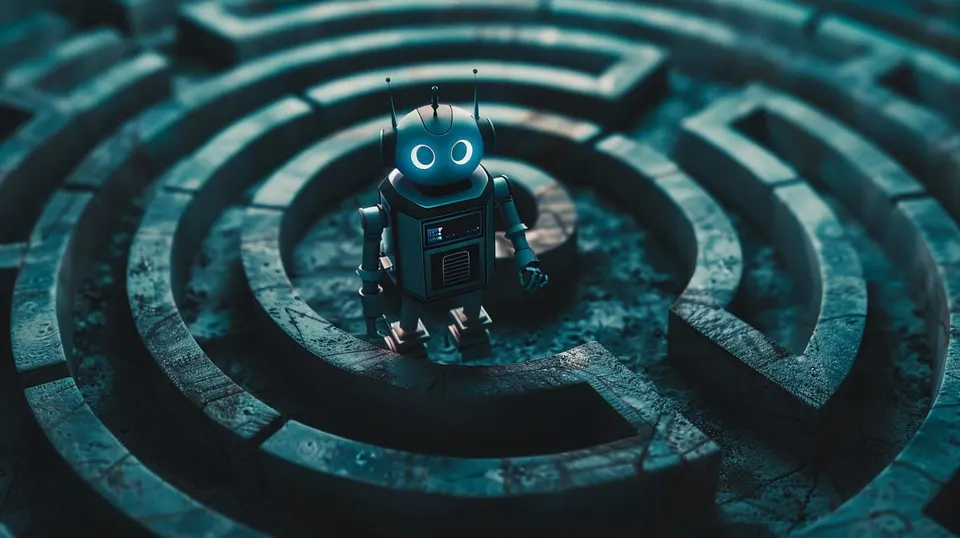
Choosing the right decision is, more often than not, what drives the plot of great (and small) works of fiction forward. That is why we will bring them together, Hamlet and ChatGPT, to look for the labyrinths of life, literal and figurative, that the electronic Virgil is ready to lead us through. And for the dead ends where it might send us straight into the Minotaur…
Five cases where artificial intelligence is already here to guide us, and five where we will have to wait (or never live to see it).
1. Elementary, Watson
It is no accident at all that ChatGPT became the big star of the new age, just as good old Sherlock remains an eternal hit wherever an inhumanly difficult problem needs solving.
1.7 billion units of information. That is how much, according to unofficial figures, has been “swallowed” by the GPT-4 model now “hiding” behind the paid version of ChatGPT. Yes, these are not words but numerical units of information, and still… if we compare it with what the human brain registers, there is no coming even close.
But let us step out of the popular cliché that does so much harm to the way we perceive artificial intelligence today. No, it does not begin and end with ChatGPT and the large language models that have been the huge hit of the past year. It is true that they are precisely what showed enormous progress in natural language processing and content generation. And they gradually brought the term “artificial intelligence” back into conversation in general, after specialists in the field had long and stubbornly avoided it in favor of “machine learning.”
Whatever we call it, though, deep neural networks can work wonders in processing huge arrays of data and finding patterns in them.
So much so that it is no secret at all—algorithms are already far better than humans at a number of tasks. How many people could you recognize by their faces? Even if it is thousands, facial recognition systems today are many times better than even the most skilled physiognomist. It is no accident that facial recognition is one of the applications of artificial intelligence that will be heavily restricted by the European AI Act. Meanwhile, it is no secret, on the other side of the globe the situation is quite different.
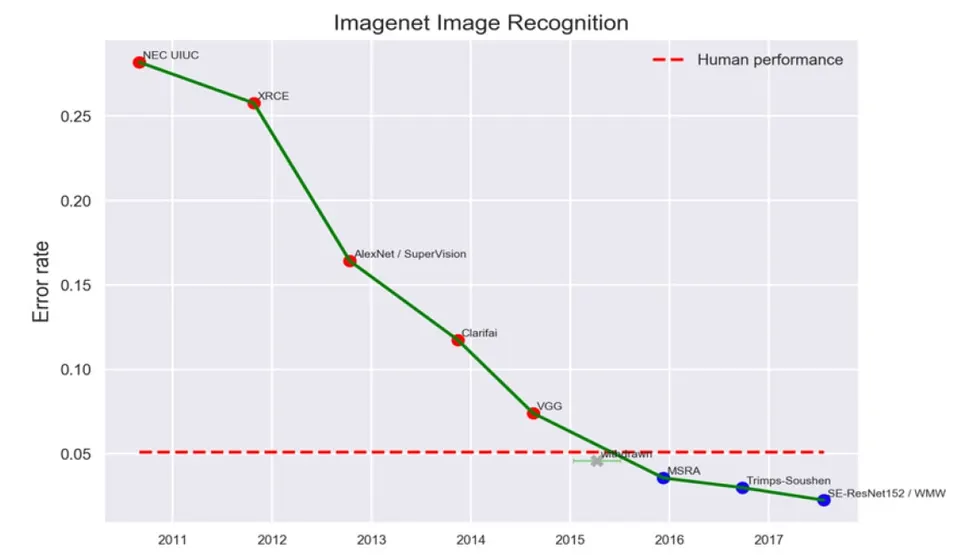
The same goes for image recognition in general. For many years there was a race between humans and computers, with an annual competition measuring how far we had come in recognizing what was in a given photo, until… with the contribution of Geoffrey Hinton a decade ago, it became clear that this battle, too, was lost.
2. Atlas Shrugged
Yes, artificial intelligence recognizes what is in a picture more accurately than a human does. We used to believe no one could beat us at chess, at Go, at quiz games… and yet that battle was lost too.
So what, isn't that a good thing? It means we can hand over to the algorithms a large share of tasks of the Atlas kind. Not Ayn Rand's hero in this case, but the classical titan who stubbornly holds all of us up on his shoulders.
At least until recently, this looked like the ideal job for algorithms and technology—to replace us where tasks are routine, can be fitted into frameworks and easily tracked. And in that direction the progress has certainly been enormous, and not even all that new. In any system where we have enough data, where it is easy and clear to define what is being sought and what the right answer is, there is no longer any need to toil like damned Minotaurs; we have a helper to do the work…
3. The Red Pill or the Blue?
Repetition and patterns were among the “signature tricks” even of the previous generations of systems with which we tried to imitate the brain. But… the surprise came less than two years ago from an unexpected place. It turned out that algorithms were already very good at generating content. Texts, images of every possible kind. Slowly but imperceptibly, they had advanced in that direction.
And so, if Neo had to choose between the two pills today and simply couldn't make up his mind… he could just ask ChatGPT. The modern Hamlet would get plenty of arguments on whether to settle for the red one, symbolizing courage, truth and unvarnished reality, or the blue… the road to the made-up world.
Just as imperceptibly and unexpectedly, the algorithm also turned out to be a good adviser, even a psychologist. “Serious research has been done on the use of ChatGPT in this field, and it turned out that the risk is very low and the benefits are extremely great, mostly because of its accessibility and the way you communicate,” says Ivan Vankov (Gatakka), one of the undisputed authorities in Bulgaria in the field of advanced technology.
“It slips into your mode of conversation and builds rapport very easily. It has been trained specifically for that with the help of human feedback. You feel comfortable with it and start sharing more and more. As a psychotherapist, ChatGPT has proven very effective for milder conditions that don't so badly need professional intervention.”
What's more, we are apparently inclined to seek help from the algorithm. It is easier when there is no fear of being misunderstood, of making a fool of yourself. “In February 2023, when the whole thing was total madness, an internal OpenAI report came out about what people were using it for,” Gatakka adds. “For a huge share of them, ChatGPT was a trash can for emotional waste—some call it the ‘bartender theory.’ Telling your deepest secrets to a complete stranger. People anthropomorphized it, gave it some kind of personality, and shared with it even their deepest fears, secrets and desires.
Everyone expected that AI would solve mathematical, engineering or organizational problems. No—people en masse started using it as an empathy machine. Someone to hear them, understand them and perhaps give them advice.”
An empathy machine! Isn't that inspiring?
Of course, when it comes to more serious psychological problems, the algorithm should by no means be seen as a panacea. Perhaps that is why this use has somehow gradually faded into the background. Making way for other labyrinths of life, by no means less important…
4. “Linger, Moment!”
In his quest for a scientific breakthrough, Dr. Faust found himself forced to sell his soul to the devil Mephistopheles. Well, in the age of artificial intelligence such sacrifices are not required.
Science is one of the fields where we expect (with good reason) serious help from algorithms. It is no accident that at the very dawn of the big buzz, Bill Gates noted that the change under way matters most because of the opportunities the new technologies give us specifically in health care and education.
“In my view, the new technologies will merge with current medical practice,” says Dr. Petko Fiziev, a bioinformatics specialist working in the heart of Silicon Valley. “A personalized approach will be added, in which we will know the individual characteristics of the person the doctor is treating and what is best specifically for them. There will be drugs made for a specific person based on their genetics and clinical history. The combination of genetics and artificial intelligence is extremely powerful, and I expect big news in the coming years.”
And all of this applies to many other medical fields too. “I think big news is also coming in pharmaceuticals. Breakthroughs there are very hard; we thought it would be easier to open up this field with artificial intelligence, but it takes time. I expect news in the diagnosis of rare diseases, too, and in predicting genetic risk.”
And what if we look farther, to the stars? “The applications of AI in astrophysics are extremely diverse,” sums up Chief Assistant Professor Orlin Stanchev of Sofia University, who has experience with precisely the algorithms for exploring the sky. “From searching for planets outside the Solar System and detecting and classifying objects, to analyzing data from gravitational wave detectors, determining the redshift of galaxies and generating synthetic data for training and validating various algorithms.”
5. “What Shall We Eat?”
All of this sounds like a beautiful promise that may (or may not) come true in the near or more distant future. Can AI find the aliens for us? Extend our lives drastically? Give equal access to education?
Only ChatGPT knows. Because, as the forecaster Hamish McRae writes, “the difficulty in predicting revolutionary changes also lies in the fact that once they have happened, they seem so obvious—how did no one think of it before?—but before they appear, we cannot even imagine that such a thing could exist.”
So before we leave the optimistic side of the labyrinth, let us peek into one more area where AI has already brought us enormous benefits (and problems).
“The history of every major Galactic Civilization tends to pass through three distinct and recognizable phases,” writes Douglas Adams in his timeless Hitchhiker's Guide, calling these three stages “Survival, Inquiry and Sophistication.” “The first phase is characterized by the question ‘How can we eat?’ the second by the question ‘Why do we eat?’ and the third by the question ‘Where shall we have lunch?’”
Yes, content recommendation algorithms were for a long time one of the hot topics in the world of artificial intelligence… before they became as good as they are today. They are in social networks, in content platforms, in web portals. And they certainly know how to hold our attention. They also do what their name says—successfully recommend what we are looking for, whether it is a book, a film or a piece of news. And yes—here, too, we are talking about deep neural networks, albeit of earlier generations.
True, as “collateral” damage came the big question of locking us into echo chambers, of filter bubbles… but that is simply an example of how, when introducing such complex solutions, we need to talk more, to look for their potential risks, including the risk of being too good at their job.
And what about the navigation systems that made the world so accessible? The next generations of recommendation systems, which promise through new models to be unbiased, more up to date, relevant and meaningful…
The light at the end of the tunnel has appeared in our labyrinth, too. And before we leave it, we ought to mention one more wonderful gift that artificial intelligence gives us today.
The chance to create! On the one hand, we can always get a fresh idea from an unprejudiced “conversation partner.” Yes, I am convinced that if we approach ChatGPT and its kin this way, it can definitely unleash new forms of creativity. And then there are the possibilities that large language models and their applications give us as a tool. For instance, for creating remarkable paintings, photographs, works of art of every kind.
Should we have given up painting when the camera appeared? In my view, the same goes for the new generations of artificial intelligence: they give a great advantage to anyone who finds a way to use them, all the more so for tasks no one had ever thought of before…
Do you know which is the only animal that can fall into the same trap twice? No, it's not ChatGPT; it learns from its mistakes.
1. “It Is Never Too Late to Be Wise”
So claims Daniel Defoe, and in that sense he is right about ChatGPT too. But the fact is that if it is our only helper on a desert island, the one we rely on for “responsible answers”… we had better give up and fend for ourselves in the spirit of the classic Robinson Crusoe.
I am sure you have already piled up quite a few objections to the brave new world painted so far, the one the algorithms lead us to at the labyrinth's exit.
Yes, despite the huge buzz of the past year, we all know by now that ChatGPT is far from human abilities, from artificial general intelligence. From the multilayered requirements we perhaps ought to set before using that famous label at all.
First of all… ChatGPT is not Google, nor is it BG-Mamma, Bulgaria's sprawling parenting forum; unlike them, it is prone to error. Of course, even the popular forum is not always entirely infallible, but it is important to be aware of the difference. GPT models are not search engines, nor sources of information. Yes, they often make things up, or more precisely hallucinate, even when it comes to seemingly obvious questions.
For example, elementary math or logic problems. These are precisely considered one of the next criteria by which we will recognize the coming big steps in the models' development.
2. “Everybody Lies!”
That's right, the quote “Everybody lies!” comes from the unforgettable Dr. House. So brilliant that with those words he practically foretold the arrival of large language models.
If we ask them about years, history, people… How, for instance, is the algorithm supposed to tell apart, in the data it was trained on, all the people named Ivan Ivanov, the Bulgarian John Smith?
In my view, the artificial intelligence specialist Viktor Botev put the answer precisely. “Over the years the main goal was to create a language model that speaks convincingly, that sounds human. And how does a human speak? They can choose words, paraphrase something that has been said differently. For the model to do that, it has to be able to generalize, to recognize the same type of constructions and use them interchangeably. But when we teach the model to generalize, that inherently means we doom it not to work very well with facts.
Yes, it knows it has to put a phone number, an address or a year as the next element in the sequence of generated text, but it has no way of knowing exactly which number to choose. Because for someone being born on a certain date, in the text it was trained on it will have seen many such examples, and each time the number will be different.
It cannot judge which one is right, because it makes no cause-and-effect connection with the specific person. That is exactly where it needs help. That is where we have to think about how to change this, so that the model, besides generalizing, can also focus on specific cause-and-effect relationships.”
3. “The More, the More”
Of course, sometimes the problem is simply the data. If your name cannot be found anywhere at all in the lists the model was trained on, if it isn't on the internet… how is the model supposed to tell you who you are if you ask it? Yes, it would be honest to admit it has no idea, but we have already passed the question of why honesty is not exactly the defining trait of today's large language models.
As already mentioned, they are strong when they have a large enough volume of data in front of them, and that is gradually becoming a problem, as Viktor Botev explains again:
“How big the model is determines how many different structures it can learn. Some, like Sam Altman, for example, believe we need even bigger models and they will learn to make these cause-and-effect connections on their own. That is why, in his view, a great deal of effort should go into bigger and bigger models.
But there is another limit there—the data. We are already approaching the ceiling, we have no more data, and people are thinking about how to synthesize new data. That in itself creates another serious problem—models already have biases, let alone if we start synthesizing data. It is not clear how this problem can be solved.”
In other words—don't expect the algorithm to lead you out of the labyrinth when it has no way of “knowing” the answer…
4. “At the Tip of the Lance”
That is exactly where freedom still remains today, at the tip of the lance, just as in the days of the famous hidalgo. “Honesty,” “morality,” “ethics,” “values”… aren't these all terms we ourselves use less and less, let alone try to explain to algorithms or embody in them?
And yet, what perhaps comes before them is common sense. Understanding at a somewhat deeper level.
“Today we have very powerful models, but they have no understanding of language. At a high level, these are very intelligent search engines. They can learn patterns, work out certain connections and find different pieces that need to be put together to arrive at the answer. But they have no real understanding of language, of the semantics of particular words, still less of pragmatics,” says Prof. Preslav Nakov, a world-renowned scientist in the field of natural language processing with artificial intelligence.
“There are various definitions of ‘artificial intelligence’; now every intelligent system is called that, but it wasn't always so. There were periods when ‘artificial intelligence’ was a dirty word; now it's the opposite, we are in a phase of inflated expectations, which to a great extent are justified, because the new models work very well for a wide range of tasks. But for what we have at the moment, ‘artificial intelligence’ is not an accurate term; it is more correct to speak of ‘machine learning.’ We have models that learn from examples and on that basis make decisions, generate text, do classification and so on.
Since ‘artificial intelligence’ as a term has already been taken over by machine learning and by systems that act intelligently, a new direction is developing that asks those fundamental questions—do we actually have true, fundamental understanding? The new discipline is called ‘artificial general intelligence,’ and it asks precisely whether we are there. Whether we can be ‘there’ in the foreseeable future. Yes, I'd like to believe we can. Systems are certainly becoming more intelligent, we can see it. The quality of both machine translation and text generation is improving. The question is rather, what do we want to achieve?”
5. “Invisible to the Eye”
Yes, that is exactly one of the big questions to which, it seems to me, we must look for the answer together—and it should rather be us leading the algorithm through the labyrinth of the future, not the other way around.
And that does not necessarily go through mathematics, pragmatics, collecting and processing data. To find that answer, we also need the human. And the more-than-human. “What is invisible to the eye”… That is why people from so many different fields come as guests to Digital Stories, united by having something to say about today's and tomorrow's technological world…
“Artificial intelligence seems funny to us; it looks like a distorting mirror or a little fool we guide, thanks to whom we feel knowledgeable and more human than ever,” says the poet Violeta Kuneva. “But this is changing literally within days, and soon it will become a realistic and faithful reflection of us. I think about that moment—probably then we will manage to see ourselves through its eyes, to understand which parts of us are clear even to an artificial creation, what remains inaccessible to it, and what is the most precious.
In my view, those are the places it cannot peer into. I imagine the future as a battle for the invisible; that will be the most important resource. What artificial intelligence cannot register is the most precious thing in us.”
The future as a battle for the invisible? Or as getting to know and making sense of the invisible? I certainly imagine it as an endless labyrinth, where every exit sets us before the next entrance. And there are more and more turns from which we emerge changed, different. And more and more of them are tied to technology…
This piece is part of the new issue of Dolce Far Niente magazine