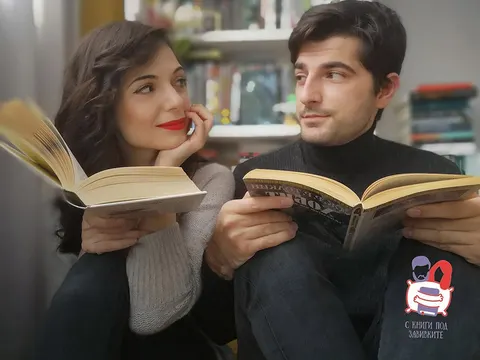
With Books Under the Covers is a digital venture about love. Love of books, and love in general.
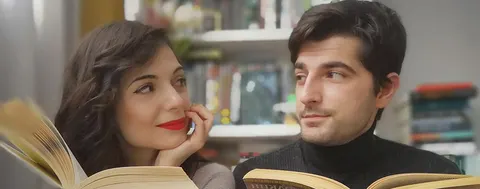
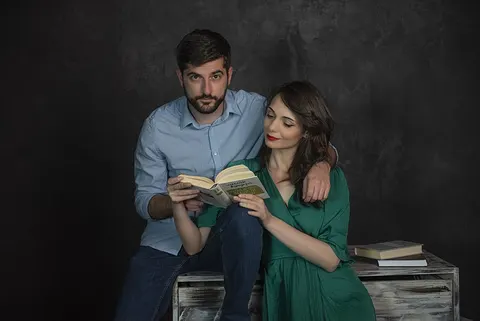
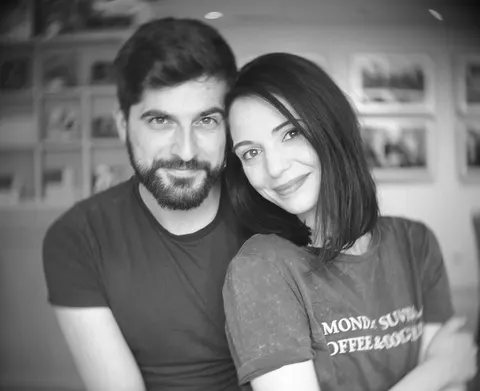
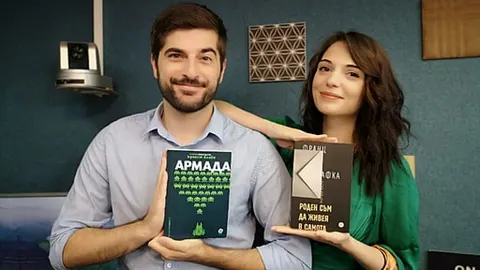
Temz Arabadzhieva is the PR at the publishing house Ciela, and Anton Birov is editor-in-chief of Webcafé, a Bulgarian news and culture site. Together they make a vlog about good old books in the digital world. Recently they added a podcast, First Page, which has already hosted favorite authors we share, such as Ivo Ivanov and Viktoria Beshliyska.
Thoughtful, modern people who love books. Book influencers… no offense meant. We dig into the pages of the past and talk about favorite reads. To look together for the dimensions of literature today and its ephemeral future.
Time for the next page… in every sense.
– Do you think paper books will disappear?
Anton: When some stray meteorite decides to follow the example of its cousin who wrecked the dinosaurs’ easy life, probably yes. Or if we trash the planet so badly that there are no trees left. As long as we exist as a species, paper books will exist too, if only out of nostalgia for “the good old days.” Even if in limited numbers, or as collector’s rarities, given what paper costs these days…
If we colonize other planets and moons, I imagine a small metal box drifting through the black abyss, in which some cyberpunked person from Titan is reading a battered copy of Terry Pratchett’s Interesting Times and laughing from the heart.

– Are there book influencers around the world?
Anton: There are, but I don’t have time for them. Their place is
between the books that deserve readers and the readers who don’t have time for wandering
around bookstores and libraries reading back covers.
Temz: Certainly, but, alas, Anton and I really haven’t dug into the subject… and maybe we should.
– Why did you start the vlog?
Anton: As readers, we know how valuable it is when someone points you toward an interesting book. We were already doing it anyway—Temz was quite active with book recommendations on her reader’s blog, Knizhno: Na po kniga, dve (Bookish: A Book or Two Each), and every now and then I wrote about books on mine. Since back then I was working as a reporter on the streets of Plovdiv,
I had developed the urge to film—her, myself, people, books, anything at all.
Temz had the idea of channeling this constant camera voyeurism into something productive.
We took a notebook, did an afternoon brainstorm under the covers, which is where the name came from, and soon after—after hours of test recordings, by then in Sofia—the first episode was born.
– What keeps you going?
Anton:
There are so many wonderful stories told on paper. True ones and invented ones.
I’d like to help, in a small way, get them to more people who would appreciate them, enjoy them and keep a warm memory of reading them.
Temz: Perhaps it really is
those moments when we feel we have connected a person and a story, and an entirely new story has been born from it,
that have become the axis mundi of our project. Sometimes it’s hard for me to imagine myself “outside the covers.”

– Are there books that, in your view, managed to paint our digital life today before it happened?
Anton: I really don’t feel like mentioning yet again
1984, but voluntarily submitting to daily surveillance is the easiest example.
The difference is that in our reality it is carried out both by states and by the private sector for commercial purposes. And most of the time we neither think about it nor care. Better personalized ads than random ones, right?
– You put that very precisely. Topics like this are one of the main reasons this site exists. Temz, what do you think?
Temz: 1984 is certainly the most popular answer. But I think much more of a book whose execution I generally don’t like, namely Dave Eggers’s The Circle. Because it was written long after 1984, Zamyatin’s We or Huxley’s Brave New World, the theme of “digitalization” is much more present in it. That novel strikes me as some kind of grim harbinger of “meta.”
– I’m noting down two books I haven’t read and probably should. But interesting… you chose rather frightening novels. Which books do you dream of living in?
Temz: If there is a book I would live in, it is Anne of Green Gables, with all its meadows and sunsets that Lucy Maud Montgomery managed to paint with words. That is, of course, my childhood answering; I don’t know whether that “lightness” of being wouldn’t in fact be unbearable for me.
Anton: I’m past 30, so nothing adventurous, please. Rather Tolkien’s Middle-earth, more specifically the Shire, even more specifically Hobbiton, but in peaceful times. Food, nature and quiet for me; I leave the adventures to the crazy Bagginses and their imitators.
– Which character would you like to meet in person?
Temz: Probably the characters I have identified with or been in love with… though that is a dangerous wish. I would gladly have a chat with Rilke’s Malte Laurids Brigge, Prince Myshkin, Achilles; I would drink a calvados with Remarque’s Ravic, meet Nora from A Doll’s House and every one of the heroines of Blaga Dimitrova, the great Bulgarian poet and novelist.
Anton: Some of my favorite characters are silent, sadistic people with a penchant for violence. Often from fantasy. The Bloody-Nine from Joe Abercrombie’s The First Law trilogy, Caine from Heroes Die… So from that point of view I’d rather our meetings stay on the page. I can’t see them being up for reflecting on the value of human life while we drink tea on the porch of my house in Hobbiton.
– Temz, if you ever manage that calvados, I’d be grateful if you invited me too—drinks are on me. But I’d be afraid of Ninefingers. Somehow he’s not suited to the way we interact today; brutality today is more insidious.
And if we move from fantasy to science fiction: Anton, you seem to be into the genre. Which writers today paint the future most convincingly?
Anton: You’re asking the wrong person in the wrong country. First of all, I was most passionate about science fiction in my early teens, but back then I read mostly classics. And I too was caught by
the growing-up syndrome, whose main symptom is that I look up at the stars less and less often,
and that affects my attraction to the genre. Second, science fiction in Bulgaria suffers from the fact that few publishers dare to publish it. The books simply don’t sell, readers seem to want something else, and so many of the big names of the genre in the West never reach us. Nobody invests in something they expect to lose money on.
In recent years I was very impressed by The Three-Body Problem and The Dark Forest by the Chinese writer Liu Cixin. I can agree with him on one thing: judging by the warlike nature of the human race, it is very likely that if we ever make contact with an alien race, they will be no less aggressive and bent on conquest than we are. Maybe it’s not a bad idea to stop sending “Izlel e Delyo Haydutin”—the Bulgarian folk song that flies on the Voyager Golden Record—into space and try to fix up our own planet.

– You are a journalist and a PR. Forgive me… but I think these are dying professions. Isn’t that so?
Temz: Astonishing! I would never have thought such a thing. Perhaps you mean the decline of classic PR, but I would by no means say the time has come to mummify it. On the contrary, the more I follow the public appearances of the “new famous,” the more necessary it seems to me. Naturally, there’s no way around it—it too has to shed its old robe with all its lace and jabot.
PR is changing, becoming more and more colorful, and seems to be taking on dimensions that are hard to grasp.
It adapts to the times, merges with other professions.
Anton: Journalism is far from dead; it is just suffering from serious health problems. A fever from the rush with which it tries to compete with the photos and comments uploaded across social media. A cough from the pressure on its lungs, attempts at which have always existed throughout history. A headache from fighting the risks that disinformation and “alternative truths” bring. To cope with these problems—at least to some extent—journalism has to evolve constantly, but while continuing to be guided by rules and walking hand in hand with responsibility.
– Will you write a book one day?
Temz: With every passing year I run from that idea more resolutely. Sometimes a person has to maintain a certain hygiene of thoughts and actions.

– What do audiobooks take away, and what do they give?
Anton: They let your eyes, tortured by staring at screens all day, take a much-needed rest. They also let you “read” in moments when you supposedly can’t do it with a paper volume in hand—for example, while walking. Not that you can’t stroll back and forth with your eyes glued to Brandon Sanderson’s 1,000-plus-page The Way of Kings, but it’s awkward, and with our sidewalks, even dangerous.
On the other hand, they take away the pleasure of touching paper, the ritual of turning the pages, the chance to go back a line or two and reread something. And above all, the chance to “hear” the book and its characters with the voices your mind gives them, rather than the voice of the actor chosen for the audiobook. So they take away a bit of the imagination in reading.
– Which of the most popular books by Bulgarian authors in recent years are your favorites?
Temz: I would name Opashkata (The Queue) by Zachary Karabashliev and She Who Remains by Rene Karabash. But I usually, like a small spring flower, creep through the shadier corners of literature, where the book or novel is not always appreciated. I adore the poetry and short stories of Dana Beleva, Patuvane po posoka na syankata (Traveling in the Direction of the Shadow) by Yana Bukova, the stories of Olya Stoyanova and Ivanka Mogilska; The Same Night by Hristo Karastoyanov also didn’t seem to get the attention it deserves.
– It’s great that you mentioned the shady literary corners. Suggest a few titles each of books you’d like to reach more people that never became especially popular.
Temz: The books of Roberto Bolaño, especially 2666; those of David Mitchell, especially Ghostwritten; Italo Calvino with his If on a winter’s night a traveler. Poetry is extremely underrated in Bulgaria; even big names like Rainer Maria Rilke or Federico García Lorca remain mostly favorites of intellectual circles, which is sad.
Anton: I wish even more people would get to know Joe Abercrombie’s fantasy world and his wonderful characters, each nuts in their own way. Start with The Blade Itself and don’t stop. I would also mention Jacek Dukaj’s Other Songs—a book that at first moved devilishly slowly for my taste, but at some point gathered momentum and turned out to be full of gripping and varied fantastic ideas.
– I’m adding more reads to my list again, one second… I hope I get to them; time really isn’t enough these days. Where do unread books go?
Anton: From a reader’s point of view—onto the list of bad purchases, and along with that into the basement, the attic, or at best donated to some chitalishte, the local community library and cultural center found in every Bulgarian town. From a publisher’s point of view—onto the list of bad decisions. But the truth is that even the dumbest book has its reader, even if that reader is the dumbest. Simply because “dumb” is a subjective notion. So unread books are the ones that just haven’t found the right readers.
Temz: An extreme statement from Anton. In my view,
unread books are simply waiting for us somewhere out there, a moment away.
– I once put together some quick statistics on print runs over the past 10 years. Unlike newspapers and magazines, books are not declining. Why have they proved so resilient?
Anton: I take a more pragmatic view of this question. I think the difference comes from the fact that with magazines and newspapers we are talking about media, and with books—about art. However many caveats are needed to apply that definition to some titles… print media are simply gradually moving into the digital environment, which for the consumer is faster, more convenient and cheaper.
The book, like the other arts, also has its digital reflection, but
at the same time the added value of the classic way of consuming it remains.
Yes, we watch films on Netflix on the couch, but there is something more special about seeing the new Wes Anderson film or a spectacle like Spider-Man: Far From Home on a big screen. We listen to music on Spotify while walking to our offices, but there is a certain romance in putting a record on the turntable in dim light. In the same way, the pleasure of a paper book in your hands has not been replaced by the ability to read it on a screen or even listen to it.
If there is one thing social media has helped with, it is promoting reading. Not only through formats like the things we make, but also through publishers’ more accessible options for advertising books online, and easier recommendations between readers.
– How long will books stay alive?
Anton: Storytelling has held humanity by the hand since its birth, helped it grow, raised it. It just changes its form—from mouth to mouth, from paper to eyes, from file to ear. So, to the question of how long books will stay alive: although I’m not the Harry Potter fan in the family, I’ll quote the most esteemed Professor Snape with his short and clear: “Always.”
Temz: As long as there are people, books will be with us.