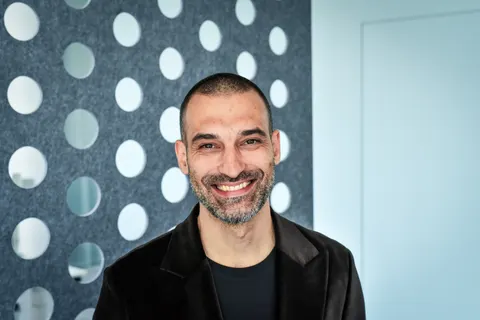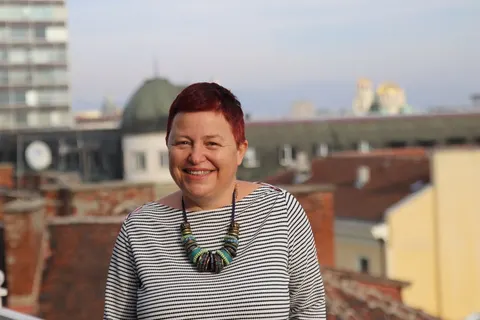
Justine Toms has rich and varied experience in the internet era—in communications, digital marketing, design and entrepreneurship. She teaches at New Bulgarian University (NBU) and at SoftUni Digital, the digital arm of Bulgaria’s largest private tech school. She organizes the Site of the Year awards, and her personal blog has been running for almost two decades.
With the eye of a scholar, a practitioner and a teacher, she follows how communication online is changing and where technology is taking us.
How can we be sure today that we are not missing something important in the flood of information? Or that we are not falling victim to manipulation? What will the new media look like after… “the death of the media”?
Will they manage the task of helping us find our bearings?
In a world that is doomed to face a sweeping transformation in the years ahead…
– You told me that my experiment with the AI-generated Eko Elena reached you through your students. So here we are, two “digital” people, and yet sometimes stories have to pass through the “analog world.” How can anyone be sure today that they are not missing something important? In the old days we read newspapers, we watched the news…
– You still didn’t know. You only thought you knew. Chernobyl happens, and you understand what happened years later. So back then we rather lived under the illusion that we knew. Now
we live with the absolute certainty that we don’t know, however much we read or follow the news.
At first, technology gave people the confidence that they would be omnipresent, that they would be able to solve many problems, but that turned out to be self-deception.
– I find that a little disheartening. And specifically the trend of delegating more and more to algorithms to tell us what has happened and what matters.
– Yes, that is the side of social networks I don’t like either. First of all, I think that
they are still wrongly called that; these are platforms that want everything from us.
And we give it to them very generously all the time, and on top of that we don’t know how they work. They keep changing these algorithms however they please. Many times, for example, Facebook suddenly shows up in English, you wonder what’s going on, and 24 hours later it’s gone. We are like a testing ground.
But that comes from the nature of digital space itself. Because on television you have a very clear timeline that you can control, and the same goes for radio. Even if something extraordinary happens, you have production time in which to check things.
Whereas here everything is live, 24/7, and it flows not on 5 or 500 channels—there are as many channels as there are people, billions. That is the big challenge, and it changes the whole paradigm of the media landscape.
The media used to have a public function, but right now they are completely reformatting it. And the platforms are slotting themselves into that as the organic supplier of everything that happens in our lives.
– I also talk about “the death of the media,” although not all my colleagues approve. I simply think it is time for them to be reborn in an entirely new form, one that fits the times.
– I think that’s exactly right! Some people still watch television, but it isn’t television anymore, it’s the same platforms, only for video content, which is again asynchronous. Classic media consumption, which is synchronous, one-to-many, is gone. The boundaries have expanded so much, and the media in their classic dimensions disappeared long ago.
– But what will this rebirth look like? My answer is that it will come through the person, the author as an authority and a validator of truth.
– The classic media are still in an era of transformation that they put off for far too long. And I think that all digital media will increasingly be exactly like that—personalized, coming through a person who is not anonymous. In the beginning the media were not anonymous, journalists wrote for them, but
right now they are trying to be more and more anonymous. That discredits them and turns them into tabloids by definition.
Whereas content like yours, for instance, cannot be discredited that way; it passes through you, you are the person—you curate the content, you select it, you stand behind it.
I think that is very valuable. Everyone who has something to say should not hide behind other brands but stand behind their own name, because that brings added value.
– But it also brings problems online, “charming” comments that inevitably weigh on you.
– Yes, it requires you to know what you are doing.
– Frankly, I’m not sure I do.
– In the course of evolution, one of the things people have forgotten to use is intuition.
And we have strong intuition! Without it being spiritual or abstract—quite the opposite. If we follow it, it will lead us. I think that’s what you are doing right now with Digital Stories—you are developing something that, on the one hand, nobody expects, and on the other, comes at exactly the right time and in the right place.
The big media are business institutions, not people; they have no intuition, and that is why they are much slower
in these processes of transformation.
– Where will these processes go from here? How will this transformation of the media end? Will they survive as conglomerates?
– No, they won’t survive as conglomerates, but that is tied to the bigger question: how society will transform. Because we can see that right now things are not happening the way they should.
Even capitalism is in its twilight, close to its end.
We don’t know what comes next or what it will look like, but it certainly won’t be driven so much by the huge businesses that are finding it harder and harder to exist. It’s the same with the media; they are part of this process. They won’t make their own revolution or new version by themselves; that will happen when the whole of society transforms. And it will happen quite fast, because on the one hand we have global warming, which will accelerate a lot of processes. We have political systems that can’t withstand the new expectations. Dictatorships that are falling apart, and big democracies that, living in this kind of hybrid capitalism, aren’t doing very well. In this process the media will undergo enormous transformations.
In my view they will go through this personalized stage, and that is why I think projects like yours are very much in the right place at the right time. They will be among the pillars that manage to carry media development into the new format.
The platforms, on the other hand, won’t die out; they will be one of the key foundations, but they too will have to find their place in this shaky situation.
– But how can we somehow bring this transformation into the public conversation? Because it isn’t there, there is no conversation about where we are heading…
– I think it isn’t there because people are generally afraid, and that is completely normal. That is also why we have the great denial of global warming, of the fact that capitalism in its current format, like democracy, like the dictatorships, cannot hold.
In other words, that we as humanity have not found a solution.
But there is no way to force this onto the agenda before its natural course arrives.
Here I want to give Turkey and Atatürk as an example. He was a great visionary and wanted to bring Turkey to a secular level, and he managed to do it by force. And then we see how another person, with a different opinion, managed to set back by a century what Atatürk had done.
– Then again, it isn’t clear whether that is really going back, or whether we are trying to impose on other civilizations models that aren’t natural to them.
– Exactly! For reasons like these, we can’t forcibly introduce the topic of the place and role of the media. Even the classic media find it convenient right now to keep the status quo; their monetization models are changing radically amid all this dynamism, because media consumption is far more fragmented.
This still can’t be grasped—the advertising market is in a strange position, and the media are suffering. Those that survive are the ones with additional funding models, but they aren’t always the ones people want or need. And they aren’t necessarily good for society.
I think it will work out. Now, with ChatGPT, with your experiment with Elena, I think we are about to take a somewhat more sober account of these processes. I believe that within the next 10 years, unless things accelerate even more because of external circumstances, we will inevitably move to a 4-day work week, and most likely soon after that to a 4-hour workday. We will have a minimum basic income, however absurd that may sound to many people today. We will rethink our daily lives, and that will open up a very wide field for people. But I’m not sure they will want to grow with the free time they will have, rather than just entertain themselves even more.
– I also keep coming back to universal basic income, I often arrive at this question and picture scenes from dystopias. One of my guests surprised me with the argument that in the Russian Empire in the 19th century there were also many people who had nothing to do but entertain themselves. And that is how Dostoevsky, Turgenev and Tolstoy appeared and created great literature.
– I agree, but… They didn’t have video games, they didn’t have the internet,
they didn’t have the endless voyeuristic scroll on TikTok and Instagram, so they could be bored well.
We have yet to learn that, because we have rather forgotten how. But as the Bulgarian saying goes, the fool is not the one who eats the banitsa, our traditional cheese pastry, but the one who hands it to him. Social platforms and technologies will go as far as we let them, and that too is one of the big tasks that remain to be solved on a global scale. The pandemic taught us that there is no longer any issue that doesn’t have to be solved globally.
We will have to set some limits on this. On ChatGPT, which is still a beta version; right now we are all testing it, and in doing so we are training it. We will have to decide what we are going to do with the media at all.
Do we need to know where and what is happening all the time? Does someone need to curate this content?
Right now the media and the social platforms do it one way or another, but we aren’t convinced they are doing it well enough.
– The answer about the media is often generational. I think that for people under 30–35 they have lost their significance as a factor.
– For my students, everything that matters is on the internet. They rarely read content that is long or outside the specific sources they have picked for themselves. That is exactly why the framework we have to put on both social networks and artificial intelligence is important. How far they should reach and how much responsibility we hand over to them.
We have handed over even the responsibility for our democracy far too easily…
– All the more so since social platforms are already stronger than states and supranational unions. But how can we regulate them, then?
– I think there is still a way. If we look globally, who can regulate them? For now, there is the most regulation of them in Europe. There is over-regulation in North Korea and a handful of dictatorships, but we’re not discussing that. Purely democratically, they are most regulated in Europe, and I think that is the right model. Personally, I am super grateful that we are part of the European Union, because we are European citizens. So I personally feel much more protected on these platforms, however defenseless we are overall. What they take from people is much more everywhere else.
So the first step is regulation, but regulation that is transposed from the European Union’s good practices to the other countries.
This balance of power really has to be evened out somehow.
Once upon a time there were antitrust measures. In my view, as long as Meta has competition in Alphabet and vice versa, everything is still fine. The real problem will come if one of the two drops out and surrenders to the other; then we will be in absolute dependence.
– I, on the other hand, think the existing regulations, including the EU’s, are a smokescreen and don’t solve the big problems. But it really is interesting how, so far in the development of information technology, we have never reached the point of a single dominant mammoth.
– Scientists and futurists suggest that within 30–40 years we will be living in the singularity. And these are processes that are inevitable in some way, but on the other hand they are part of certain patterns. I would rather look at everything that is happening not with fear but with curiosity. The media are not dying, they are simply transforming, and everyone who does it slowly and doesn’t understand what is happening will drop out, purely through evolution.
– You mentioned the big question for the media—monetization. I don’t think a good enough solution has been found for it yet. Even if it’s a subscription, that still puts everyone on an equal footing, and more will go to those who are liked, not necessarily to those who keep to standards or choose the important topics. Maybe they should somehow be funded by the state, by society?
– There are models showing that when the state pays, it works. The BBC is a great example in that respect, but there are no ads there and they work in a completely different way.
The truth is that the media have always been owned by some rich person. The first ones were the pamphlets, the Gutenberg era. Who could print pamphlets? Only the rich, because paper, ink and presses were expensive.
Then new models come in, advertising appears. Now, with this media fragmentation, advertising is quite different. Not long ago we worked on a project, we researched European media, we were in Brussels and made recommendations. One of them was to support small, local, independent media projects.
On the other hand, there are more and more models like that of Govori Internet (“The Internet Speaks”), where a few hundred people pay small monthly fees, a kind of crowdfunding, which I also think works to some extent. Of course, they won’t become millionaires, but they will be able to sustain their media presence and work on new projects.
– Vladimir Petkov of Govori Internet has been my guest. So has Georgi Nenov, “The Superhuman”. He, however, says he isn’t really a medium.
– It isn’t true that he isn’t. All such projects start from the top down—someone has an idea, starts working on it, just as you put in effort and consistency. For years you build a brand, people start to have expectations, and you turn into a medium. You can’t say you’re not a medium.
Look, right now podcasts are an absolute craze; at least one or two new ones launch every week. I thought this would stop around the pandemic, but on the contrary, it grew. Every Tom, Dick and Harry is making podcasts; I think this will settle down within a few years and only the worthwhile ones will remain.
But all these ventures need to realize the responsibility of being media.
Anyone with a lot of followers today is a medium. And what they write on their wall is a responsibility.
– You have a book about podcasts—how do you explain their rise? Fatigue with the fast formats all around us? Or the fact that they are convenient to listen to while we do something else? Or the scarcity of in-depth content…
– All of that. On the one hand, because they are very convenient to listen to. The data show that the youngest—people up to 25—don’t listen to podcasts. Because they have enough time to scroll and watch videos. In Bulgaria the podcast is very wrongly considered a video format; by definition it is audio only. So a key factor is the convenience for busy, rushed people to consume this kind of content while driving or working out.
Podcasts, blogs like yours and the classic media act as a counterpoint to the great rush on the social platforms. They
offer slow, long content, which, my thesis goes, is considerably more valuable.
With the other kind, you have a feed that changes every 15 minutes. It increases your appetite, but these are fast carbohydrates. You eat something and 15 minutes later you’re hungry again. Whereas if you come across longer content that is yours and that draws you in, you consume it more slowly, you stay with the topic. And afterward you keep living with that content; it fills you up. It is very telling that in Bulgaria the most popular podcasts run 2–3 hours. Clearly many people need the older, long forms.
– At the same time, the fact that my site has only long texts turns away 9 out of 10 people who might read them.
– That’s not a problem. A long time ago I studied digital marketing in Denmark, and my guru there, Alan Jenkins, used to say something I will never forget:
“Maybe only one person will read this content, but it may be very important and valuable to them.”
Obviously 9 out of 10 won’t read it, because they don’t have the patience, it doesn’t matter to them, it doesn’t interest them. But there will be people for whom it is crucial. You write for them, not for the others.
– What can we do to get more people into that “group”? To remind everyone else that it is sometimes worth reading something long and carefully, not just scrolling…
– Regulation alone won’t do it. When there is regulation, it means someone else decides for us. It has to come through self-regulation. Unfortunately, it’s clear that part of society won’t manage.
When cinema was arriving, my father was little and used to skip class to watch films, and they considered him a real rascal. He would slip in between screenings, hide between the seats and watch. Yet the result was not that he failed to cope with life or that cinema harmed society.
I think things will regulate themselves at some point.
We can’t ban the internet or ChatGPT, but we have to find the strength to set limits.
Not externally, but each one of us. Every year I go on “digital diets.” I stay 2, 3 or 4 weeks without the internet, or with 10 minutes a day, just enough to check my mail and my bills.
I think this should become some kind of norm. Roughly like with food—the moment there’s too much of it, it’s cheap and accessible, people start having problems with obesity. Then we realize things aren’t right. Some, unfortunately, don’t get it.
– Besides understanding the problem, you also need willpower. I often make this comparison too—we talk about cooking, about how “you are what you eat,” but I think you are much more what you read.
– Both matter—with one you feed the body, with the other the soul. You have to be responsible toward both…
– I hope these reflections have been of value. Even to one person, as your guru said. Enough to make them think…
The conversation with Justine Toms continues “in reverse.” I am her guest on the site The Creators – the Digital Optimists of Bulgaria, where Justine asks the questions. Read it here!