Today we use ever simpler speech in our daily lives, foreign borrowings easily push out beautiful Bulgarian words, and artificial intelligence handles the spelling of our native language better than most people on social media. Instead of rich Bulgarian, we massively speak and write a crippled newspeak, and the reversed evolution of our language is increasingly visible in our children. Many of them cannot tell a story or describe something, and they do not know Bulgarian, even in the upper grades.
How can language divide us today instead of bringing us together?
Holidays—and May 24, Bulgaria’s Day of the Slavonic Alphabet, Education and Culture, is one of them—also come so that we can touch on important topics and talk about the big problems we otherwise have no time for in the bustle of everyday news. That is exactly what we will do with today’s guest.
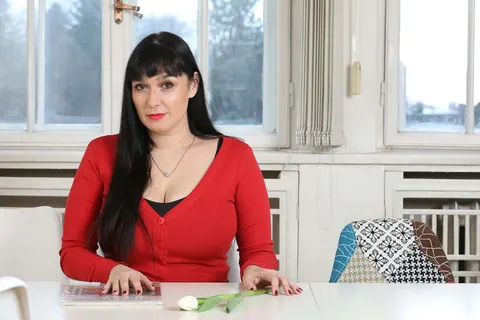
Doroteya Nikolova teaches Bulgarian language and literature. She has worked in journalism as a political reporter and in PR. She takes part in many joint initiatives with the literacy platform Kak se pishe? (How Do You Spell It?), among them the Words of the Year campaign and the new venture, Life Has No “aUtocorrect”.
“We are making our language poorer and poorer. Online we communicate in short, simplified sentences and use an awful lot of abbreviations. This newspeak is a way of simplifying how we think and squeezing ourselves into a mold. Voluntarily, imperceptibly, step by step, without realizing what we are doing, we are drastically narrowing our view of the world…”
– You say that instead of Bulgarian we now use “newspeak,” a simplified and ever more simplified language full of foreign words, which simplifies both our communication and ourselves. You believe this is even taking us backwards in evolutionary terms. Why?
– In my view, step by step we are moving toward voluntarily cutting back our most human tool—language, the thing that sets us apart from the other animals. We have reached the point where humanity is now thanks to our mental, intellectual and cognitive abilities, and to an exceptional degree through language.
We are in the middle of a peculiar evolutionary experiment as far as cognitive abilities go—we have reached the peak of exploring the world, changing it, subduing it, creating things, connecting more and more. And in the end, the fruit of all this turns out to be a double-edged sword. The world we live in now, largely because of the rapid development of technology,
is starting to take us backwards in the sense of what we understand as most human—communicating, understanding one another, developing, creating.
The language we speak reflects the way we live and think, but not only that—it turns around like a mirror and shapes the way we will think and live.
Watching children, I notice many alarming trends. They are global, but here in Bulgaria we try even harder to speed up the irreversible slide down the slope. For centuries, a community built its language and made it an ever better, ever finer tool; it learned to handle many meanings, to embrace and explore the world, to open horizons through language. And now we are on the verge of losing all of that.
– How do we recognize this newspeak?
– Our language is growing poorer in several directions.
We speak in ever shorter sentences, in ever smaller bits of language.
More and more often we don’t even use actual language. Online, where most of us spend an enormous amount of time, we exchange emoticons, pictures and images, including ones generated by artificial intelligence, which we do not reflect on through language.
It happens to me very often that
when I talk to my students, they can’t explain something to me—they want to show it to me instead.
We are talking here about a delay in the cognitive development of the Homo sapiens child. For several centuries now, after a certain age, a child has been taught to read, write, think, solve problems and dig into cases, and that is no longer happening.
Children en masse cannot put their thoughts into words. Deprived of their language, they simply don’t notice a huge part of what is going on, things that we, the older linguistic creatures, register.
At the same time, we too are making our language poorer. Online we communicate in short, simplified sentences, with far too many abbreviations.
This newspeak is a way of simplifying how we think and squeezing ourselves into a mold.
Voluntarily, imperceptibly, step by step, without realizing what we are doing, we are drastically narrowing our view of the world. We use countless abbreviations and foreign words that come through English but are not thought through in our own language—they are stuffed in as a foreign construction.
– Maybe that’s the only way to understand one another in the fast-paced world of technology…
– But the opposite can happen too. Lately, when I listen to our language, I often find I don’t understand it. Yes, I get what is being said, because I get that it comes, say, from some English construction and is being stuffed into the Bulgarian sentence.
We are losing vocabulary, impoverishing our language in terms of the words we use, and polluting it excessively with foreign words. But that’s not all. We are now starting to destroy its grammar—something linguists until recently thought impossible.
It is very important that we pay attention to this problem, because language is our most precious possession as human beings. And as a matter of national identity, too: Bulgarian is an exceptionally rich language, with many ways to express thoughts and nuances. We are destroying it and making it more primitive, clumsier, cruder, unable to grasp reality.
Besides, we are starting to speak different languages. Jargons, which are something natural, and slang are beginning to dominate, while the literary standard falls behind. Of course, they make sense as something different and interesting; people feel protected within their community when they use them. But it gets to the point where, because of their excessive use in public, jargons first lose this most valuable quality of theirs, and, on the other hand, we start splitting into separate groups that cannot understand one another.
We are losing the common ground, the common code that our literary language gives us.
– This again has a lot to do with technology as “machines of division.” Yes, foreign words are natural in every language. But it has been said here too that the problem lies in their sheer volume, in forcing them in when we already have a suitable word. And in our atrophied word-making…
– Yes, loanwords are a good thing—taking words from foreign languages for which we have none of our own. But it is even better to encourage word-making and invent words with the resources of our own language. It is such a beautiful game of the mind.
Loanwords are something that can be accepted. But
foreign words are those brazen invaders we let into our language, and little by little they impoverish it.
Often we have several established words for a given meaning, many of them of foreign origin, but, let’s say, that whole palette of five words carries different nuances. Then some new word becomes fashionable, a borrowing from English, and in order to resemble one another, to somehow be one whole, we forget all the others and start repeating only that one. Or very often words come in that we don’t fully understand but that are fashionable in, say, “Brussels-speak.”
Then come constructions that don’t agree with our grammar. Something
I notice with great shock is that in Bulgarian we are starting to lose our prepositions.
These are the logical links in phrases; they connect words and show the relationship between them. First I began to see children using prepositions they translate from English. But in Bulgarian their use is completely different. We could say, for example, that there is an excessive use of the prepositions “in” and “toward,” and for any reason at all. The sentence turns into a hodgepodge, an absurdity. I thought that was a nightmare, but now I notice the next step. Children develop their linguistic ability so little that sometimes they no longer use prepositions at all.
I hear a kind of savage language—verb, noun and no preposition, or if there is one, it is strange and you can’t tell why it’s there and what it expresses. That, I think, is truly frightening. It is the first stage of language, back when it was being formed. That’s why I talk about evolution in reverse, and in a shortened time. Some kind of experiment we are all taking part in.
– That there is a big problem with comprehension is evident every year from the remarkable results of the matura, Bulgaria’s school-leaving exam. With entire schools getting failing grades of 2, the lowest on the six-point scale—on a test that could be passed almost by guessing. But what can we do?
– That’s true. For us teachers, it has long been clear that there is a huge problem with understanding texts. Honestly, I don’t know what to do, as someone who is currently trying to help people learn their native language. Linguistic ability develops every second of a person’s life; it isn’t learned at school. There you acquire the literary standard, grammar rules, how to handle language, rules of style. You train the ability to write and read, and from there—to think. Because we, as linguistic creatures, think to an enormous degree through language.
The cure is reading, listening, writing, and talking a lot with one another in good, complete sentences, so that it becomes clear what thought we want to express. Helping those who can’t by supporting them with a richer vocabulary, showing them.
Language should be acquired at home, in relationships with relatives and peers. Another frightening thing happening to Bulgarian children right now is that they start talking very late. Perfectly healthy children. For a human child to develop its potential, to become a social being, to master linguistic abilities, it must first be taught by adults. And we have evidently abdicated from this role.
– Could this reversed evolution you’re talking about actually be natural? Aren’t we becoming a civilization of the image, where the main thing is to look at pictures and take things in quickly, as on Instagram and TikTok? Where you have no time to stop and think, to read a novel from cover to cover…
– What would such a civilization of the image be like—and the literal image at that? To build our present-day life, we went from image-based to deeply symbolic creatures, because language enables much deeper symbolic thinking. Through it we talk about things that aren’t here. Using only images, exchanging photos or even pictograms, could we build a spaceship to take us to another galaxy?
– Many tech specialists I talk to say that one of the great skills of the future is describing exactly what you want. But according to everything said so far, that is precisely what we are losing.
– Linguistic abilities develop in several ways—first, children must hear the language, then speak it, learn to express themselves, to tell something in an orderly, chronological way, in complete sentences, so that the person in front of them understands. The role of adults, when children are small, is to show them, correct them, encourage them, help them with words and correct constructions. That evidently isn’t happening in the modern Bulgarian family. Many of the children from 5th to 12th grade whom I teach arrive with huge gaps that should have been filled back in kindergarten.
Another thing I think we do very wrong: we shield children from every kind of problem. A person’s intellectual, cognitive and learning abilities develop when they have a problem, have to share it with other people through language, explain it, and then come up with a solution together. Here we are no longer talking only about language; it is part of a huge system.
Language is a fundamental part of our ability to think and make sense of the world.
For thousands of years of evolution, you had to be constantly on the alert to survive, reproduce, find shelter, escape a predator. When we watch the great apes, for example, we notice a constant shifting of attention; they can’t focus for long and keep changing the object precisely for these evolutionary reasons. Right now, through our screen devices, we are turning the state back in that direction. We are changing the structure of our brain, rewiring its connections so that we can shift our focus quickly, but also so that we can’t hold it.
For the last several centuries we have read, written, solved problems, built houses and developed these abilities in a very laborious way. I see that today’s students give up very easily. The natural desire and impulse is to make things easier for yourself, to not do something. Only this leads to a lack of important, key skills.
In any case, we are talking about developmental delays and deficits. And adults too—we built our brain one way, but now we are reconfiguring it; other neural connections are forming, tied to the myth of multitasking, of doing everything at once. That is a step back toward our monkey brain. We cannot accomplish something difficult that requires thought and concentration if we keep redirecting our attention.
– Besides reading, what can develop linguistic culture? I think it has always been the main factor. When you talk with someone, the goal is to find common ground; there’s no point in introducing styles and nuances, whereas literature is what demands them. Or at least it used to; in my view, in recent years it too has visibly become uniform in style.
– I agree, things are escalating so fast that I don’t know how they can change either.
Literature gives an enormous wealth of ideas, words, synonyms, different ways to think or say something—that is priceless.
Many people growing up now have never tasted this “treat” at all. And I think that is what we must try to change.
It is crucial that at the beginning, when a person builds their competences and intellectual skills, effort is required. Right now we spare children that effort and cripple them. If we push them, if we create an environment where they are a bit “pressed” to read and learn, then once they cross a threshold of difficulty and take the next step, they’ll get the chance to feel how good it is. Because they will already have the toolkit to understand. To read something,
to be alone with themselves and not be bored. Because they are terribly bored every second they are left without some external stimulus.
I also notice that in current literature the trend is to go back to the monkey brain. Where chapters used to be longer, to hold attention longer, many new novels have short sentences and quickly changing scenes.
We are adaptive beings; adaptation is what the environment demands of you in order to survive and develop. And
if we say that today’s children aren’t motivated—that phrase horrifies me—why is that? Because the environment demands nothing of them. Nothing! They sit there like potted plants, tapping away.
And the moment they stop, they feel restless, irritable and bored. Because we haven’t helped them build the toolkit for having an inner life.
– Are there texts you teach that they like, that manage to win them over? In other words, do they care about Baba Iliytsa, the old woman heroine of Ivan Vazov’s poem “A Bulgarian Woman”?
– To understand a text, you have to immerse yourself, in a sense, in the culture, the historical period, the setting; you have to imagine that world. It has become almost a mantra to say how hard Under the Yoke is for them and what archaic language the novel uses. True, it is very archaic. I spent a long time doing other things, and when I returned to teaching, I had to refresh my memory of the texts. There are many words that are so far back in time that the everyday objects they refer to no longer exist. Not to mention that the language itself has changed a great deal.
For this text to be understood, the cultural environment has to tell the story. When I was little, there were films about the Ottoman yoke, about the Liberation of 1878, about Vasil Levski. That kind of mass culture doesn’t exist now.
The whole of society has given up on its history and on engaging with its roots, so children have no way of learning the basics;
we have to tell them at school. The European trend is to learn through experience, and we don’t do that. Why not use augmented reality precisely for lessons on how Baba Iliytsa crossed the river with that pole we have all dreamed about?
When you tell them, when you explain, they become interested. But it’s hard, and one of the reasons is precisely that we can’t hold their attention; we can’t be TikTok and play a new video every 20 seconds. They have to manage to concentrate, and the moment they take that step and succeed, it becomes interesting to them.
– Which works catch their attention?
– Most of them do, although, I agree, the curriculum isn’t perfect. When I prepare seventh-graders, almost all the boys find Vazov’s novella Nemili-nedragi (The Unloved and Unwanted) quite interesting—sad as it is, it’s an adventure story with interesting characters who aren’t black or white but full-blooded and contradictory, just as all of us are.
“A Bulgarian Woman” interests them too; Baba Iliytsa is a strong and interesting character.
It can bore you if you stay on the surface. You have to go a little deeper to see and imagine what happened,
because this is also a very dramatic story, and a story of the spirit at that. In the upper grades there are also many works connected with their growing up. They study Yovkov and Smirnenski, but also Don Quixote and Shakespeare. The point is to let themselves get into the work.
Just as they like Harry Potter—a pleasantly written series with a good translation that includes word-making too.
Language is the boundary of our world.
It shows how far we have mastered it, how well we know it, and it helps us look for the next step. If we need a word for something new, we must find it. This is where artificial intelligence comes in, feeding on the resources of the internet. It picks the most frequent and popular answers, drawn from our everyday communication at that, and turns into a cliché machine. It leads to an ever greater narrowing of language.

– Interestingly, even AI can come up with interesting ideas for new words—right here ChatGPT invented two words in the dialect of Bulgaria’s northwest for me that, to me at least, sound resonant and “like the real thing.” But we come back to the starting point: we surround ourselves with clichés, as I discussed with Alek Popov a few months before he passed away… But specifically in the Bulgarian setting, aren’t the media also to blame for our poorer everyday language?
– I too was used to journalists constantly facing very serious criticism. Somehow society’s entire set of expectations very easily shrinks down to what journalists do and how they behave. And I took that responsibility on myself, until one day someone I was talking to said: “I think we delegate too much responsibility to journalists. Society is actually made up of all of us.”
I changed fields, and I found that in other areas, too, professionals are very often criticized. Then, looking around, I realized that
in every sphere we have started to look at things through our fingers.
There are no standards of conduct in almost any profession—medicine, teaching, journalism. We have abandoned norms of behavior—striving for a standard that is good for ourselves, for others and for all of us as a society. Because good conduct, culture and civilization help us all live better.
Journalists used to have enormous influence; today that isn’t so. But people who gain access to the public sphere continue to influence the linguistic environment and wield enormous power. Anyone with that access would do well to be aware of it. Right now, however,
we all have such access to some degree through social media, and so we keep pushing the responsibility for the linguistic environment further and further down the ladder.
If you allow yourself to write carelessly online, you become part of the general linguistic background, and things move along—only downward.
– If it hasn’t seemed important to you so far, why is it worth trying to write correctly?
– First, that way you show respect for yourself—that you are a knowledgeable, capable, literate person. You show respect for your language, for the culture you belong to. As a people, our self-esteem limps badly. Remember the words of Paisius of Hilendar, the 18th-century monk who urged Bulgarians not to be ashamed of their language. Since distant times there have been signs of how we love to swoon over foreign languages and cultures and fail to value our own. It shows that we don’t believe in ourselves enough.
Once we tried to be Greek, then the worship turned to everything à la franca, to French. Dobri Voynikov’s play Krivorazbranata tsivilizatsia (The Misunderstood Civilization) is a wonderful source on this subject. Then it turned to Russian, and now to English.
Bulgarian is the oldest written Slavic language, the one that gave writing to all the others. It is highly evolved, developed and rich; we have something to be proud of. It is a wonderful tool, and the better you master it, the more possibilities you create…