“It seems simpler to me for people to remember what is fraud and delusion. A short and by no means exhaustive list: homeopathy, holistic medicine, naturopathy, anti-vaxxism, colon hydrotherapy, detox diets, astrology, extrasensory perception, clairvoyance, telekinesis (and all the made-up phenomena that fall under ‘parapsychology’), UFO-based ancient civilizations, graphology, mediumship, quantum mysticism, perpetual motion machines, free-energy engines, creationism, biorhythms, cryptozoology…”
Do you believe in astrology, in the power of chakras, in reptilians, in a flat Earth? Perhaps you belong to today’s minority, for whom none of this is to be taken seriously? Or maybe you can’t deny that star signs shape behavior, while the rest strikes you as extreme? Yes, today, as never before, we need landmarks so as not to drown in the ocean of online madness. And at the same time it is getting ever harder to talk to one another.
Divided by yet another rift, we argue over who is peddling pseudoscience and who has let themselves be misled by the authorities. With today’s guest we will look for a path toward this difficult but long-overdue conversation—about conspiracies and pseudoscience, about science and authority.
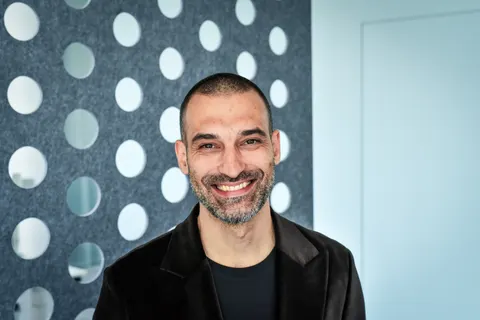
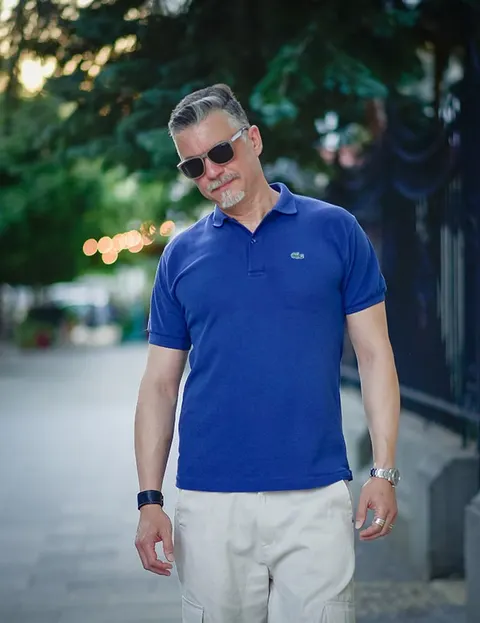
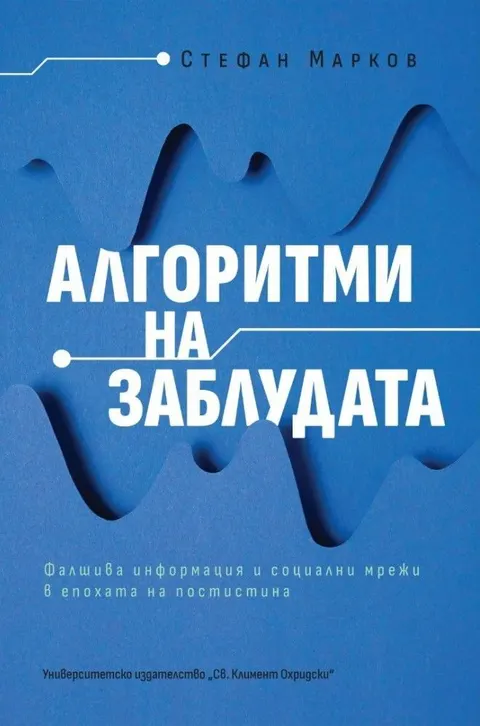
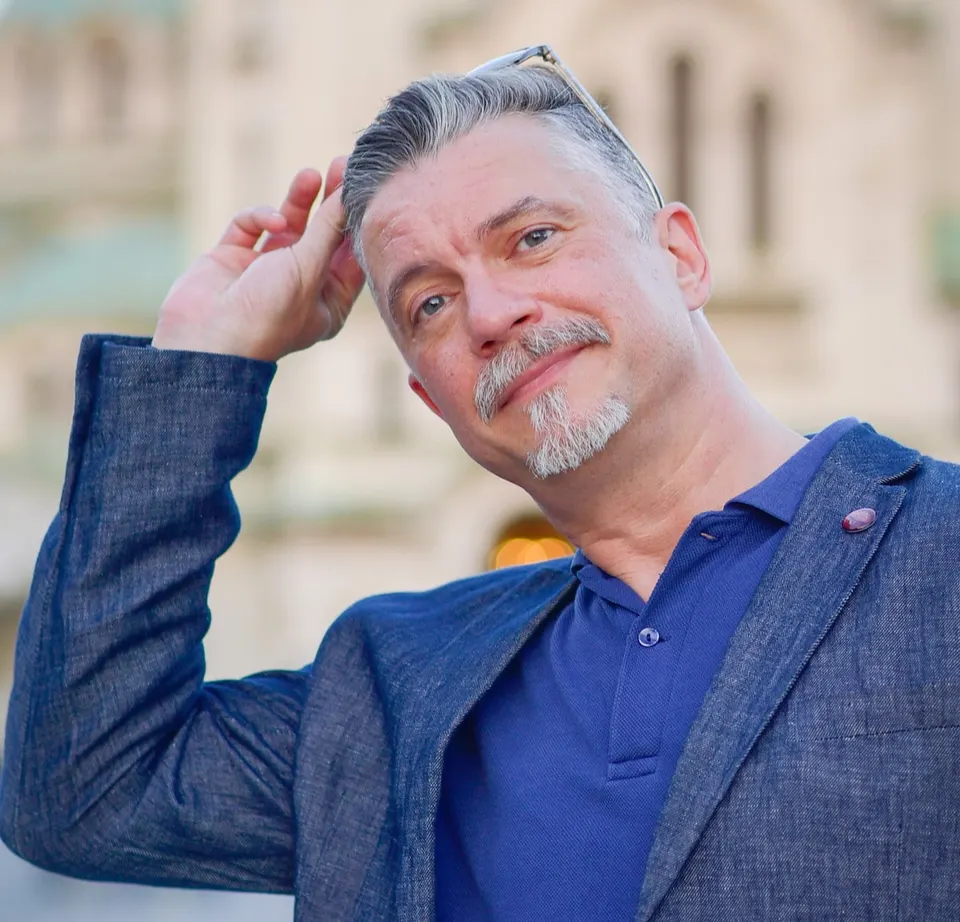
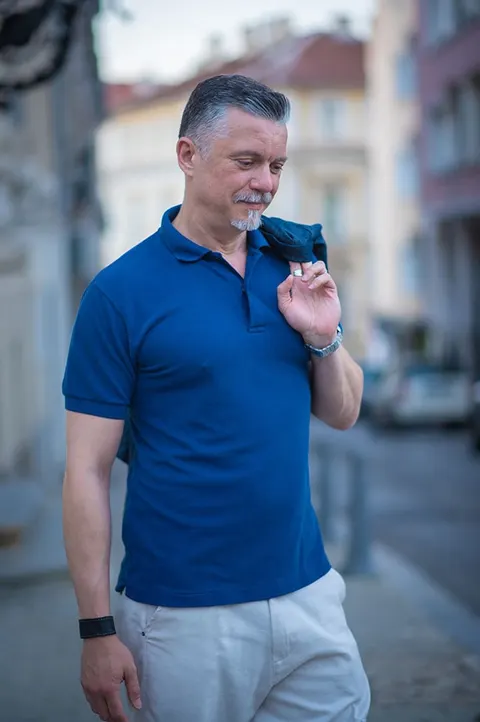
Stefan Markov teaches mass communication theory, communication management, and marketing and advertising at Sofia University, and is known online as The Science Guy. In his recently published book Algoritmi na zabludata (Algorithms of Delusion), he goes straight to the heart of this subject. Among his intriguing ventures (and ones that matter a great deal to him personally) is also the podcast Modern Stoicism, which he hosts together with Petar Teodosiev of Bulgarian Science.
– “What’s your star sign?” What does it tell you about a person if they open a conversation that way?
– The previous “version” of me would have answered differently, but over time I’ve learned to think that whether someone believes in star signs, or in homeopathy, isn’t necessarily a clear signal of their intelligence or their capacity for critical thinking. We humans believe in all sorts of things and for all sorts of reasons. This is very important, and it is a cardinal mistake to look only for the rational or logically sound side of things.
From the Nobel laureate and psychologist Daniel Kahneman we can learn that the everyday concept of “knowing” has two components—the absence of doubt and the factual, verifiable truth of what we say we “know.”
Scientists draw very firm boundaries around what counts as “knowledge.” For them it is only that for which objective evidence exists. Any scientist would tell you that believing something is right or true carries no guarantee whatsoever that you are right. Things look entirely different in other communities or groups of people. For every devout Christian, for instance, there is no doubt at all that God created the world 6,000 years ago, that He then sent a flood, that His son Jesus Christ lived on Earth, died and rose again three days later. This form of conviction is completely different; the believing Christian knows with their heart that they are right and that the whole narrative is factual down to the smallest detail.
But to get back to the essence of your question—
people believe in star signs for emotional and pragmatic reasons—that belief satisfies important needs of theirs.
In Algorithms of Delusion I explain in detail what modern social science knows about this phenomenon and why it is thought that people believe in astrology and other pseudosciences. Most often the motives are social.
– To be honest, my own reaction to questions like that has changed quite a lot over the years. And what seems especially important here is to stay as far as possible from absolute positions and generalizations. Astrology, of course, is just an example. But what are these social motives?
– To understand the world and ourselves, to feel we belong to some community, to be effective, to have self-respect, and to see the world as benevolent.
Without much difficulty we can see that pseudoscientific doctrines, and astrology in particular, can satisfy such social needs far more successfully than traditional science.
The world is far more chaotic, anxious and incomprehensible than we would like, and science has nothing comforting to say. There is no way it can reassure us.
Quite the opposite—it is more likely to unsettle us, because it tells us the facts, and facts are rarely pleasant or comforting. Against this backdrop, a pseudoscience like astrology has a soothing effect on us; it gives us a well-grounded sense that it is at our service, it helps us put the chaos in order and find answers to hard questions. Even when those answers aren’t true.
– But how did we reach a point where science has lost its power over a huge share of people?
– We form beliefs in basically two ways. One is logical and rational, the other emotional and associative. And most often we use the second. We look for consistency, coherence and an absence of discord in the stories we believe.
If something sounds convincing to us and we trust the person we hear it from, we are very likely to believe it.
So it is with astrology. It is convincing, soothing, explanatory, plenty of authoritative and likable people believe in it, ergo it is massively widespread. Even the big media outlets have been running astrology shows for years—how could anyone not believe it, when they see it “on TV”?
Believing in star signs is practically convenient, because it is in sync with life experience, and it seems to you that what you hear is entirely correct, valid, verifiable, familiar from everyday life. When someone tells you Cancers are gentle or Capricorns are stubborn, you reply: “Yes, exactly! I know a whole bunch of Cancers and Capricorns like that…” It is convenient to have an idea in advance of what kind of person someone will turn out to be and what you can expect from them.
Of course, this is absolute, complete self-deception, but it is a rather pleasant one.
And our brains love to feel pleasure, literally. They like the chemicals these sensations bring.
You are looking for a rational explanation for astrology’s triumph, and there is one—it just isn’t the one you expect. The rational explanation lies in the emotional and associative way in which we humans most often form our convictions and beliefs.
– A perfectly logical and important explanation. My sons are both Virgos too and they are quite alike, and I hope to raise them as critical thinkers. A young reader told me she hears from everywhere that she should think critically, but never what critical thinking means in everyday life. Does everyone have to spend hours checking a piece of information to be sure it’s true?
– “Critical thinking” doesn’t mean nitpicking or quarreling. The term comes from the Greek “kritikos,” meaning “able to judge.” That is, to tell good from bad, to recognize truth and lies. And success at this is achieved through specific standards of justification—you can learn more about the subject from Assoc. Prof. Rosen Lyutskanov’s book Narachnik za kritichesko mislene (A Handbook of Critical Thinking).
In psychology there is a specific tool called the CRT—the “Cognitive Reflection Test.” It is designed to measure an individual’s tendency to reject an initial, often wrong, intuitive answer and to engage in further reflection to find the right one. It largely defines people’s cognitive style and shows how inclined each of us is to “dig deeper.” Most people aren’t especially keen on that sort of thing, because in principle
we humans are “cognitive misers” and avoid straining our brains.
It is simply hard, tiring and resource-intensive; it burns a lot of calories. And so the people who do poorly on the CRT believe more untrue things, including astrology and extrasensory perception. Translated into plain language—if you’re too lazy to think, it usually shows, and you’ll believe just about anything.
– All right, but as you write in the book, astrology is a relatively harmless pseudoscience. Yet pseudoscience and conspiracy theories today are far from always harmless…
– There are some striking examples—politicians running the country on astrological advice and guidance from their favorite astrologer, as Silvio Berlusconi liked to do, and he wasn’t the only one. But astrology truly rarely has grave consequences. Unfortunately, there are a number of other pseudoscientific pursuits that can have a devastating effect on us—individually and as a society.
Above all I mean “alternative medicine,” which is worryingly often a form of pseudoscience.
Take homeopathy, so beloved by many anxious mothers. Most people don’t have even a basic idea of what lies behind the word and mistakenly think of herbs, natural ingredients and so on.
It is something else entirely, and not a particularly clever one. It was invented at the end of the 18th century by the German charlatan doctor Samuel Hahnemann. It rests on two principles—similarity (like cures like) and infinite dilution, also known as “potentization.” Both are visibly absurd;
science has tested homeopathy countless times with double-blind experiments, and the conclusion is invariably the same—this “system” works only at the level of the “placebo effect.”
That is, only as much as we believe in it. And it couldn’t be otherwise—the first principle isn’t based on anything scientific. Why would something that causes certain symptoms in a healthy person be able to cure the same symptoms in a sick one?!? The second is downright crazy—that the more we dilute an active ingredient, the “more powerful” it becomes. In homeopaths’ solutions not a single molecule of the diluted substance remains, but its “memory” supposedly does all the work. If solutions had memory, I personally wouldn’t touch tap water. Because, as you can easily guess, at least some of it has certainly passed at some point through the kidneys of a very sick stranger…
The frightening part comes if we stop treating serious illnesses with conventional, science-based means and lean on homeopathy instead. And while I don’t much care about grown-ups, since everyone has a head on their shoulders and is responsible for their own future and happiness, I am genuinely worried about children. They don’t choose their treatment personally and on an informed basis. Someone else does it for them and in their place.
– When did we start losing the battle with pseudoscience?
– There is hardly an exact moment. I think the internet and its mass spread across every layer of the population played an important role. I’ve been an active internet user since 1997, when I raced velociraptors through the streets to run and pay for my access at the local provider in downtown Sofia. The online world quickly filled up with a representative sample of the population you would meet on the streets of any town.
This is undeniably very democratic, and it opens doors for everyone to educate themselves, to grow smarter, to develop, to do business, to learn, to profit culturally, politically, socially, financially and in every other way. But as we can see, that isn’t quite what happened. Instead of all of us progressing, a small share of people use technology for their own benefit and growth, while the rest have learned to use it mainly for other things—playing games, chatting, swapping and gawking at pictures of kittens, and scattering not-very-intelligent babble everywhere. I don’t know how to put it more delicately.
– I would add that online the “rules” are set up to steer us in that direction, which is why this site exists too—to make us stop and think.
– The internet is a wonderful environment for spreading stupidity, ignorance, conspiracies, lies, delusions, hatred, polarizing narratives…
This “digital divide” drew a new demarcation line through societies around the world—winners and losers from internet use. The winners are few, those who strive to build themselves up with the help of technology. The losers are the majority, and they mostly waste their time online. Let me not be misunderstood—I too sometimes spend time on pleasant pastimes online, and years ago I did so much more. Today, though, I try—and this is a natural impulse!—to extract maximum “profit” from sitting in front of a phone or a computer.
The internet is a megaphone for nonsense.
We turned it into one because of anonymity. As someone once pointed out, if everyone wrote comments but with a scan of their ID card next to their profile name, things would look different—the hate, the trolling, the harassment, the nonsense, the lies and the delusions would be a hundredth of their current size. But things are what they are, and pseudoscience and the other lies and delusions claim new victims every day—figuratively and literally.
– Hate, anonymity, division, filter bubbles… Exactly! But literally, even?
– Delusions poison people’s souls, minds and bodies almost equally.
When you meet people like yourself and move in homogeneous online environments, the lies gradually become part of your understanding of the world.
But when you start applying them, your life may end up staked on the wrong card. During the COVID pandemic thousands of people died from misleading self-treatment advice. In a situation like that, even if the internet had never been invented, foolish advice would still have spread. But the internet made the world a small place in which the aggressively stupid, the greedy and the self-important have the power and the will to shout down the thoughtful and the decent. Which inevitably increases entropy and leads to more, and more frequent, bad decisions by significant masses of people.
– Or the issue of COVID vaccines… Would you go to a doctor who believes in star signs or homeopathy?
– A basic piece of advice from circles of critical-thinking enthusiasts (amazingly, there are such communities online too) is exactly that—when we go to a new doctor, we should first ask whether they would recommend homeopathy. And if it turns out they would, we should run to another one. I haven’t applied it in “real life,” although I find the advice entirely sensible and justified. Then again, I haven’t had the bad luck of a doctor reaching for homeopathic remedies.
As for star signs—I have no problem with that. Doctors aren’t obliged to know that astrology is pseudoscientific, and even if they believe in it, as long as they are competent in their specialty and keep their knowledge up to date, I fully trust that they can help me within the bounds of what is reasonable and well-founded.
– Why are there so many doctors and teachers who believe in pseudoscience and conspiracy theories? They are educated—shouldn’t we trust them, if they know medicine better than we do?
– I wish I could give a humane and non-irritating answer to a question like that, but I don’t see how. Honesty requires me to admit that the public image of doctors and teachers as “smart, educated and trustworthy” people is quite far from reality in far too many cases. And with these levels of pay, social benefits and public recognition, it is no wonder that not many intellectually brilliant and professionally competent figures have remained in the ranks of those professions.
– Can anyone tell, by some criterion, what is science and what is pseudoscience?
– There are plenty of features that distinguish science from pseudoscience. Science is falsifiable (that is, open to refutation), empirically provable, methodologically sound, open to criticism, verifiable, reproducible. Pseudoscience doesn’t have such features, and that strongly unmasks it on closer inspection. But precisely because the criteria are so numerous, it can be challenging for a layperson to tell the two apart “in the field.”
In the end, it is a rather unnecessary demand to place on people—if they aren’t experts in science, they can’t be expected to start analyzing which statement, claim, publication or article is scientific.
It seems simpler to me for people to remember what is fraud and delusion. A short and by no means exhaustive list: homeopathy, holistic medicine, naturopathy, anti-vaxxism, colon hydrotherapy, detox diets, astrology, extrasensory perception, clairvoyance, telekinesis (and all the made-up phenomena that fall under “parapsychology”), UFO-based ancient civilizations, graphology, mediumship, quantum mysticism, perpetual motion machines, free-energy engines, creationism, biorhythms, cryptozoology, flat Earth theory…
– That’s quite a list!
– There is more, but I think even this incomplete list will “inflame” plenty of readers for one reason or another.
People love to believe the fairy tales that make them feel good; on the other hand, there are millions of swindlers making hefty sums out of gullibility.
The latter will brand me their enemy or competitor, because I am “leading astray” their religious community. I understand them—what charlatan with business interests would want someone “muddying the waters”? The funny thing is that I’m actually trying to do the opposite—to clear the water, so people can see where they are heading and what reality is. But here I contradict a core principle of mine—not to give advice to people who haven’t asked for it.
– And when is it important to make the distinction?
– Let everyone judge by their own lights. I would say that if a person’s health or life is at stake, it is extremely important to understand what is pseudoscience. Beyond that, “important” becomes a rather relative term. Personally, I think it matters not to multiply absurdities and misleading narratives, but my opinion is entirely non-binding and reflects only my own intellectual taste for living in society.
– We have both mentioned the pandemic; it became a catalyst for all these processes. What do you think were the biggest communication mistakes that contributed to this?
– The communication mistakes by everyone involved in managing and containing the global (and the Bulgarian) crisis were so abundant and varied that I won’t venture to single out just a few.
As far as I could judge at the time,
probably every country “botched” its communication to an astonishing degree.
It is quite certain that some hold the palm of victory, and I suspect Bulgaria is one of them. It is one of the five countries with the highest “excess mortality” during the pandemic. The term measures how many more people died than would be statistically expected, compared with the same period before the pandemic.
Let me quote a paragraph from my monograph Algorithms of Delusion: “Clearly, the incidence of and mortality from the coronavirus correlate with the political governance of countries and the actions of the authorities. Those very actions were noted by voters in the respective countries, who, watching the unfolding health catastrophe, withdrew their trust from public institutions and turned to ‘alternative’ sources of information. Thus disinformation, and to a particularly great extent anti-scientific conspiracy theories, received a powerful boost and wide circulation. With which the circle closes, and the health situation in the affected countries deteriorates to the maximum and irreversibly.”
One of the reasons for the poor communication, by the way, was that we had never before lived through a pandemic in the modern era of total global connectivity, and nobody knew how to act. Every scientific discovery overturned the previous one, and the authorities often had little choice but to say something different every day and issue contradictory instructions. A very difficult situation, managed by not particularly gifted politicians and power holders, often pursuing their own shady interests and having lost public trust—there was no way this cocktail could lead to positive results. A society can be led successfully even in such times if it trusts its leaders and considers them competent and well-meaning. In Bulgaria we had no particular reason to see those in power that way, and the result is well known—a communication catastrophe, tens of thousands dead needlessly, chaos.
– Today it is beyond dispute that because of our skepticism toward science (and vaccines in particular), many people died who could still be alive. But how do we convince the rest that they were wrong, so it doesn’t happen again?
– If vaccine skeptics were dangerous only to themselves, I wouldn’t lift a finger at the social level. But anti-vaxxers are dangerous above all to (their) children. By not vaccinating their offspring, they punch holes in the long-built vaccination shield that has so far protected modern humanity quite successfully from extremely unpleasant and dangerous diseases. The higher the share of unvaccinated people, the weaker our common shield becomes. That is the second problem—anti-vaxxers are dangerous to society as well. The falling number of vaccinated people is a threat to all of us, even if we ourselves are vaccinated.
Anti-vaxxers are grown-ups—if they want to get sick or die, that is their choice. But that choice, unfortunately, isn’t confined to them alone. It affects innocent children and society as a whole.
– And still, how do we convince such people?
– That really is the million-dollar question. Until we realize that we humans form our convictions mainly emotionally and associatively, not rationally, fighting anti-vaxxism by logical and scientific means will bring us almost no success.
If we truly want to help these people change their views (rather than force them, which never works well), a different approach is needed.
It has two components—good storytellers and stories.
No, I’m not recommending “fairy tales for grown-ups,” but excellent and emotionally compelling narratives, told tirelessly by excellent and very widely liked opinion leaders with a proven, powerful persuasive effect. It is scientifically confirmed that our convictions really are shaped by way of emotional liking. We simply trust someone—a teacher, a religious leader, a parent, a friend, a scientist, an influencer…—and start absorbing their views as correct.
We find arguments in favor of those views not because they are necessarily very logical or rational, but because we like (even subconsciously, without realizing it) one of those figures very much. When we argue with an ideological opponent, we find rational arguments for why we are right—not the other way around, where we know we are right because we reached our convictions rationally. And that’s okay, since we really haven’t reached our convictions and beliefs by rational means. The whole business is extremely emotional (and therefore irrational).
If we find persuasive people who are liked and recognized by society, and proactively equip them with a correct and convincing story that sounds emotionally appealing, the battle against anti-scientific or pseudoscientific beliefs starts to look winnable.
The world needs good “storytellers,” emotionally engaging and appealing stories, if it is to learn anything at all.
– So far, though, that hasn’t been the case…
– Most young people hate science not only because it is hard for them, but because they didn’t like their teachers and, along with them, came to hate the subjects they studied.
Unscrupulous influencers chasing personal gain fabricate insane nonsense on the internet every second, because they make a great living from it.
They simply satisfy a need young people have—to be shown the world as one-dimensional and completely fake, but intriguing, in counterpoint to the complex, boring, brain-straining lessons at school, taught by teachers who are often (fortunately not always) haughty, poorly prepared, arrogant, embittered, unmotivated, unable to understand their students across the generational gap, behind the times in their field, or simply weak educators.
What kind of competition can that be—personally motivated, young, slippery and morally unencumbered “storytellers” from the same generation, against the “class” of teachers I just described, who have also taken on the task of delivering material that is frankly difficult? Here the outcome is “written in the stars”…
– Should we care that, writing about science and technology, you and I will have a few hundred readers at most, while the popular faces of pseudoscience will have hundreds of thousands?
– You should care, because the Digital Stories site isn’t, and shouldn’t be, just a hobby—it has a business side too. If people don’t read you, it won’t be worth the time you put in, unless this hobby of yours nourishes you endlessly on a purely human level, regardless of the financial return.
– That’s true, the site is entirely non-commercial, and that gives me freedom. Precisely because I feel an inner need to tell the stories that I too believe are the only way out…
– I cared for a long time, because for inexplicable reasons I thought I had a duty to educate “the people.” Fortunately, today I’m not quite in the same position. I’ve been someone who has deeply revered sayings and proverbs since childhood—often enough, centuries of generational experience have crystallized in them, and we shouldn’t try to accumulate it on our own. Reinventing the wheel is a waste of time; that task was ticked off long ago, which is why I use proverbs almost every day. One of my three favorites in recent years is this one—
“You can lead a horse to water, but you can’t make it drink.”
Nobody can be convinced of anything if they have no desire or inclination for it. And since I got tired of banging my head against human walls, and don’t find it constructive for either side, these days I try not to hand out “wisdom” unless I am explicitly asked for advice or guidance.
But to get back to the question—if people prefer the influencers you mentioned, that is their business, not mine. My job, and yours too, is to offer engaging and scientifically sound content, and whoever wishes is welcome to come and read, listen, watch. It would probably be socially beneficial if what we do were the preferred choice of the mass audience, but since it isn’t—and it really isn’t—there must be reasons. Whether they like us is beside the point.
Look, we are not responsible for other people’s behavior, thoughts, actions, values. Even if those people are our children (or students), we can achieve only a limited effect. And that shouldn’t trouble us all that much.
Let’s do our work conscientiously and without losing enthusiasm, and if we manage to influence even one person in a positive way, I think we should congratulate ourselves on a success.
Because even that isn’t guaranteed, and counting on anything more would show a poor capacity for judgment…
– That’s exactly how I see it too. Every reader is the reader who matters, and I wish you the strength and the will to keep going down this path. Thank you for this conversation!