“Online, You Can See How Weak a Person Really Is…”
“The past is theory, the present is practice, the future is the result. In that sense the future is a moving concept; it can change, and change many times over,” says today’s guest, who admits she keeps away from social media because their atmosphere is fundamentally at odds with her values. Kamelia Kucher is a young writer whose novels Nosht (Night), San (Dream) and Dom (Home) carry an unexpected maturity, capturing the patina of the past along the thread of a powerful story. We sit down over a cup of virtual tea to talk about newsfeeds, the Second World War, motherhood and the future.
 302
Sam Altman, the Father of ChatGPT
Have you heard of Sam Altman? The famous ChatGPT owes its success to him; he runs OpenAI, the company that showed the world how far artificial intelligence has come. By all signs, he will be the next big name. He will make the Silicon Valley news that echoes around the world. His few interviews are worth listening to closely as we look for the big news coming in the world of artificial intelligence. A programmer who never quite happened, an entrepreneur who has seen both success and failure up close. An innovator who landed in exactly the right place. A visionary without grand words. An American of Jewish descent, the first leader on such a scale who makes no secret of being gay. This figure, still hidden behind the chatbot, has yet to give birth to big stories and big changes. And conspiracy theories, everything that comes with his status. Not long ago he set aside from his “savings” two sums of hundreds of millions of dollars each and gave them to research into dramatically extending human life and the search for cold fusion—a technology that could solve humanity's energy needs for the long term…
 303
“ChatGPT Is Just a Very Expensive Parrot”
“We don't know what nonsense ChatGPT will come out with next, because it is just a vast extrapolation of billions of sources, of terabytes of text. However much this machine seems to talk, it is really just a very expensive parrot. It burns through $3 million a day in electricity and has no idea what it is saying.” Mariyan Gotsev has more than 30 years of experience in information technology—as a programmer, but above all as a system-level architect and analyst. His other great passion is philosophy—he immerses himself in the search for meaning. Add to all this the fact that he is a poet. I was struck by his manifesto for a venture he calls “meaning robotics,” or “semantic robotics,” in which he argues that the much-hyped language models ChatGPT and GPT-4 cannot cope with many of their tasks because they do not look for meaning. Instead, they try to offer the most accurate answers possible through the well-known method of brute force. They look for patterns, yet remain far removed from human understanding, and so, in his view, they have reached their limit. Mariyan Gotsev, on the other hand, is convinced that a new approach could give us a technology that comes close to the human way of thinking. That is our occasion to talk about the much-hyped technologies as overpriced parrots. Can we really give computers common sense, and why does our guest believe the only way is to give them meaning? Can a machine think from a human point of view? Why must our relationship with future semantic robots necessarily be that of slave owners? And why did this computer specialist acquire domain names that he is selling for millions?
 304
Ten Analog Stories in Flight: Inside Rafaelo Kazakov's Photo Collection
Capturing the moment means something different now than it did in the days before TikTok. Or does it? These photographs will remind you why photography will outlive social networks.
 305
“Technology Is a Labyrinth We Locked Ourselves Into”
Could spirituality, rather than technology, be the path to the next step in our evolution? On Sunday, March 19, director Nikolay Vasilev premieres Vaklush, a feature film more than 20 years in the making, about the spiritual teacher Vaklush Tolev, who largely changed his life and worldview. A conversation about mystical knowledge, the coming transition many religions speak of, and the wings that might carry us out of the labyrinth of technology in which we feel hopelessly lost.
 306
Artificial Intelligence and Ethics: 10 Big Questions
The astonishing progress in artificial intelligence is a fact: technologies like ChatGPT have made it clear that scientists have taken giant strides, and these will go on producing big news. This has pushed the ethical side of such work to the forefront, and the answers may prove vital for each of us and for us as a species. While the European Union and the major powers prepare some form of regulation, the AI revolution is already unfolding before our eyes. What are 10 of the most important questions we should be asking more and more often?
 307
“Our Chance Is to Give Young People Know-How”
Did you know that a Bulgarian was deeply involved in making Finding Nemo, WALL-E and other cult animated films? Antoni Hristov’s story is even much more than that: he landed in Hollywood at just 20, spent 18 years as an art director at Pixar, crossed paths with Steve Jobs, and then came home to build ARC Academy, a school for visual arts. How does Hollywood look from here, and Sofia from over there, and what is the future of creativity at a time when technology throws down its great challenges?
 308
The Programmer Who Turned Down $10 Billion
Jason Citron knows all too well what it means to fail. He has done it many times, spectacularly, losing serious money. That was before he created Discord, the next-generation social network that long ago outgrew the world of gaming and became a convenient and secure means of communication, free of many of the flaws of traditional platforms. But how did the programmer come to turn down an offer of… 10 billion dollars from Microsoft?! What failures did Jason go through before reaching his enormous success? What are the most important things he has to tell us, and the key lessons of his fascinating story?
 309
“History Today Is a Sword Blunted by Abuse”
What is worth freeing ourselves from as a nation? Does unity still make strength? Novelist Neda Antonova, one of Bulgaria’s most widely read authors of historical fiction, talks about what we owe our greatest figures, what the Apostle Levski would do if he were born today, and the calmer, wiser view of history we lose while squabbling online.
 310
Digital Stories Turns Two! Which Articles Did You Read the Most?
Digital Stories turns two today! Which of the 219 pieces published over that time were read the most? Topics well worth not missing, that much is certain… My heartfelt thanks to every one of: – More than 6,800 followers of Digital Stories on Facebook; – More than 3,600 followers on LinkedIn; – More than 500 people who subscribed to the mailing list; – More than 190,000 readers who visited the site. Over these two years the project: – Twice won the Technology and Innovation category of the most hotly contested journalism competition, the Web Report awards, and once the competition organized by the Bulgarian Association of Information Technologies. – Ran regular rubrics in Manager magazine and on bTV's business news. It was featured on bTV, BNT 1, BNT 2, Bulgarian National Radio, Darik Radio, BTA, Dir.bg, the magazines InGlobo and Osem, and many other media; – Most important of all! It drew attention to a range of topics that grow more important and pressing with every passing day. Thank you! Every read and every share matters!
 311
“Nothing Will Replace the Human Programmer. Not for Another 10 Years, at Least”
Will artificial intelligence soon put programmers out of work? Is the end coming for the huge demand for specialists, the hunger for talent, the good conditions in this industry? Is an algorithm on the horizon that will outstrip human intelligence? How is technology leading to the end of liberal democracy? We hear the view of someone from the heart of the software world. Mihail Panayotov has a long and colorful track record: he has been programming since he was 14 and started his first business at 15. He has more than 18 years of experience in a range of roles, from programmer and software architect to chief technology officer and entrepreneur. Add to that his interest in politics and his intriguing view on why it is time for more and more people from the software world to enter it.
 312
Krasi, Running Toward Himself
By the time he turned 30, he had piled on quite a few pounds and was sliding down the slippery slope of alcohol, cigarettes, even drugs… He decided it was time to change. He stepped timidly into the nearest gym. Then he started running. Not to run away, but to keep running, ever forward… and inward, toward himself. He hasn't stopped to this day. He has finished dozens of marathons and ultramarathons and logged more miles than some of us put on our cars. He has run across the Sahara in temperatures that could melt a chip. And beyond the Arctic Circle, where the inhuman cold can snap off the finger that reaches for your phone. Krasimir Georgiev is here, and he keeps running toward himself and for the sake of others. Soon he faces an even harder task—to spend weeks alone with himself, in front of all of us, with nowhere to run. To remind us who we are, where we are headed and what truly matters in our lives…
 313
BAIT Award Goes to Digital Stories!
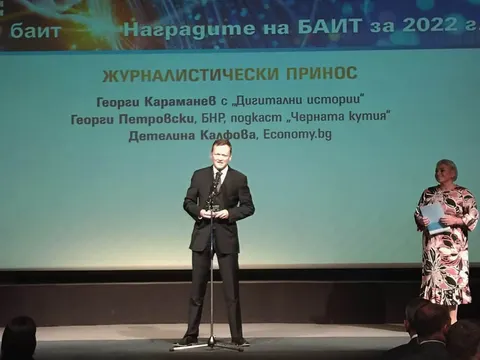
Digital Stories has won the journalism category of the annual awards organized by BAIT, the Bulgarian Association of Information Technologies! The prizes, presented for the 12th time under the patronage of President Rumen Radev, are a leading accolade in the IT world. For two years running, the site and its creator Georgi Karamanev won the technology prize of the Web Report awards, judged by leading journalists; now comes the prize from the association with the deepest traditions in the information technology sector. Where technology meets the humanities, the human, the emotional—where journalism meets programming—that is where Digital Stories lives, and that is why the prize means so much.
 314
Kademlia: The Bulgarian Algorithm Behind the Decentralized World
Kademlia is the name of one of the most significant technological solutions in information technology ever created by a Bulgarian. Never heard of it? Then it's high time! Petar Maymunkov created, almost as a joke, the system that is now widely used across the world of decentralized solutions, from BitTorrent to Ethereum. Kademlia turned out to be exactly the right answer at the turn of the millennium, when the internet took its decisive step away from centralized systems and toward the path that led us to blockchain. The scientist and his creation deserve their fame, and here is why.
 315
Dwarf Fortress: Life as a Game
Did you know there is a computer game that resembles… 50.04 percent of… real life? Dwarf Fortress has a huge number of devoted fans, has earned cult status over its 20 years, has been admitted to a museum of games and inspired the creators of Minecraft. For two whole decades it was developed voluntarily, on donations alone, by two dreamer brothers who gave everything to their adventure. Until that same adventure… quite unexpectedly turned them into millionaires. The story of Dwarf Fortress is as strange as the game itself…
 316
Yasaburo Hachiya and a Love Beyond Time
Life is a writer without equal, able to dream up plots beyond the reach of even the most gifted pen. Such is the odyssey of Yasaburo Hachiya, one of the most beautiful and powerful love stories I have ever heard. For 37 years the Russian Klavdia Novikova and the Japanese Yasaburo Hachiya lived together in a little village with the cheerful name of Progress on the banks of the Amur, dreaming of dying on the same day, on the same pillow. The samurai had even made two coffins of oak boards, lacquered, dried and assembled in the attic… But the story was not fated to unfold according to plan.
 317
Tristan Harris: The Knight of Honest Technology
“The closest thing Silicon Valley has to a conscience”—that is how Tristan Harris is known. His name made headlines with the notorious film The Social Dilemma, which drew plenty of attention but never led to much real change. His work embodies everything that is “broken” in today’s online life: the manipulative practices that have become a threat to our future as a species. Tristan Harris is not only the most recognizable champion of a free and democratic internet. Not only a thorough researcher who draws attention to the ways we are manipulated. He is also the man who warned a decade ago that the path technology was taking would lead us into a world of mammoth companies more powerful than the largest states. Into a time when we can no longer hold our attention while reading. Into filter bubbles that grotesquely distort the way we get our information. Does he think we can reverse these trends? Can the internet become a free place without monopolies, where information is delivered democratically, with respect for the personal data and views of every user… What are his ideas for the future of the web?
 318
Who Are You, ChatGPT? 5 Masterpieces, 5 Flops and 5 Big Questions
Which camp are you in? The skeptics, for whom ChatGPT is much ado about nothing? Or the fans, who believe it is leading us into an incredible future? ChatGPT is an undisputed superstar, and everyone has been tempted to try it. Our feeds are overflowing with astonishingly accurate answers, with the algorithm's spectacular blunders and with news about it. Let's try to gather the most interesting and important of it all. We begin with 5 impressive digital stories born of the chatbot, continue with 5 of its remarkable flops, and end with 5 big questions our famous conversation partner puts to all of us and to our civilization…
 319
“Nothing Can Replace Reading!”
Leda Mileva was a symbolic figure of Bulgaria's 20th century, and this is one of her last interviews, in which I had the good fortune to be the one asking the questions. The daughter of Geo Milev, author of the famous “Little White Bunny,” she was a writer, translator, journalist, even a politician. How did she see the computer future? Would technology prove stronger than literature? And how did “Little White Bunny,” the piece its author liked least, become her trademark? Leda Mileva was born on February 5, 1920, and passed away on the same date exactly 93 years later.
 320
“Machines Remain Naturally Unintelligent”
How did underestimating the ethical side of artificial intelligence lead to enormous problems that have shaken the foundations of our civilization? What AI regulations is the EU preparing, and could they slow the boom in the field? How did the web move through its successive stages, and what should we expect from Web 3.0? Vladimir Petkov (Kaladan) has worked in IT for a quarter of a century, watching the past and present of information technology up close while waiting for the future. His experience lies in data and innovation, and for six years he and his friend Elenko Elenkov have been making the cult podcast Govori Internet (The Internet Speaks), now a whole platform of podcasts as varied in subject as they are consistent in quality.