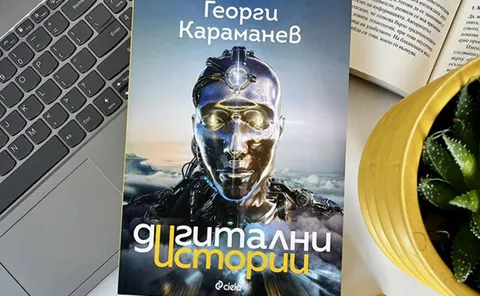
Exactly a year ago, on March 1, 2021, the Digital Stories site was born: a small island of essays and reportage about the latest technologies and the challenges they put in front of us. Together we set out on a journey where two worlds meet, the humanities and technology, in search of our shared future as a species.
It’s time for presents! Any of you can win a unique T-shirt with the project’s logo (no exaggeration—on Friday you’ll find out why). All you have to do is answer:
What is your favorite digital story?
Answer on Facebook, Instagram and LinkedIn.
What should the next digital story you want to read be?
Suggest it on Facebook, Instagram and LinkedIn.
You can take part on every platform and answer each of the questions. The deadline is March 20, 2022, and the winners, who will receive 10 T-shirts in total, will be drawn by lot. They will be announced under each of the posts on the respective social networks on March 21, 2022, and here as well.
What a Year!
A whole year! 104 articles, published every Tuesday and Friday. We gave the floor to thoughtful guests from all kinds of fields who have something to say about our digital present and future. We welcomed programmers, writers, scientists and artists.
We told countless exciting stories connected in one way or another to the world of technology. We talked about some of the pioneers of the tech world and about meaningful Bulgarian ventures online. We told of remarkable lives lived in the past, because of the digital or in spite of it.
We went deep into the thickets of technology, into fields such as artificial intelligence, blockchain and robotics, which are sketching out tomorrow. We looked closely at the way we get our news today and at the future of the media. We paid special attention to the risks that today’s technological world poses to humanity. And of course, we didn’t forget to have some fun.
This is only the beginning! If you like this beginning, help Digital Stories reach more people. Every kind word, every share matters.
Over this year Digital Stories has made a lot of friends. The site was visited by 89,586 people, according to Google Analytics. They came from as many as 124 countries. The site now has 3,589 followers on Facebook and 899 on LinkedIn, and the numbers on Instagram and Twitter are slowly growing.
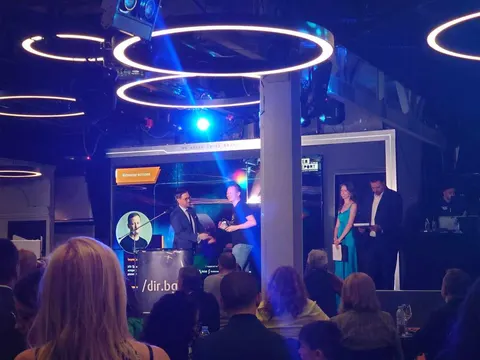
The very first piece, No!vinata (a pun on the Bulgarian for “the news” and “But! The Blame”), devoted to the future of journalism, won the grand prize in the Technology category of the Web Report awards for clean journalism, organized by Dir.bg and judged by a jury of leading journalists. Not long ago the project also made the top three nominees in the annual awards of BAIT, the Bulgarian Association of Information Technologies. Our topics regularly appear in the pages of three magazines and many other media.
Thank you from the bottom of my heart for your trust!
Do you like Digital Stories and want to help the venture? There is exactly one way to do it. Tell more people about the articles, share them on social networks and outside of any network. Because today not everyone has the time or the desire to read long texts like these, but their topics definitely touch everyone.
I’ve prepared one more modest present for you. Here are the 5 most-read stories of the year, worth a look if you missed them. And 5 more that, in my opinion, deserve to reach more people.
Happy reading, and see you in the next stories!
The Five Most Read
1. “How Do You Spell It?” “Idunno”
It certainly wasn’t just the ticklish topic of the definite article in Bulgarian, but far more the importance of Pavlina Varbanova’s project that drew the most visitors to read the interview with her.
How Do You Spell It? is a cult website for every Bulgarian online who cares about writing correctly. We met its creator, Pavlina Varbanova.
How do people write in the digital world? What are the most frequently searched mistakes? Is it time to drop the needless rule of the “full” definite article, the special ending reserved for the grammatical subject? Why is it important to take care of language, of the words we load with messages?
2. Rumen the Cat: Teh Internetz egzists to giv peepl akses to moar kittehs
“teh onli thing i culd do wuz eet, sleep and go to teh litterbox. wiht thees skilz i had no uther choys of profeshun but to becum an inflooenser.”
This beloved conversation partner of Digital Stories rarely gives interviews. We can safely say that if it weren’t for our digital present, he wouldn’t have given even one. And that would have been a loss for readers, because his thoughts are sincere, colorful and delivered in a style all his own.
3. “When everyone starts talking about bitcoin, don’t buy!”
Valentin Mihov is the man you need if you want an up-to-date technological view of decentralized finance and blockchain technologies.
What does their future look like after yet another record in the price of bitcoin? What are the technological risks? What will happen once the last bitcoin is mined? What does everyone who decides to invest in cryptocurrencies need to know?
4. 2022, Sixty Years Earlier. What Did the Science Fiction Writers Get Right?
Today we are in 2022, but let’s take a peek back. In the 1960s, Isaac Asimov wrote an impressive essay containing some astonishingly insightful predictions. Around the same time, the first issue of Kosmos, a Bulgarian popular science magazine for young readers, published a similar text gathering the ideas of Soviet science fiction writers on the subject.
What did the writers get right, and where did their expectations fail?
5. Grigori Perelman. The Last Mad Genius
The mathematician Grigori Perelman became a global star after solving one of the “Millennium Prize Problems,” which matter for the technological progress of all humanity.
Then… he turned down the $1 million prize that was his due!
The story of the undisputed mathematical genius of our time is not only fascinating but also quite instructive…
+ Five Personal Picks
1. No!vinata
We already read articles written by robots every day. Today the most valuable resource isn’t oil, and it isn’t money. It isn’t gold, and it isn’t even power. At the epicenter of the computer revolution, everything is information.
Zdravko wants to become a journalist; Zhelyazko, whose name comes from the Bulgarian word for iron, is an artificial intelligence. Who does the future belong to?
2. In the Bubble of the Like-Minded
All the big websites take care of us almost like a father would—picking the most suitable content for us, saving us time and effort. But this is turning into a serious problem for societies. Because the filter bubble makes us more closed to different opinions, more aggressive. It brings many of our ugliest sides to the fore. It strips us of nuance and of the beauty of communication.
The filter bubble is a problem that is swallowing us more and more, while we talk about it less and less. It’s high time that changed…
3. Truth… or Dare?
Where did the professions whose job is to create content for an audience begin, and how far have they come? Who fights for the truth, and should that matter to us today? Where did influencers come from, and why is it important to make sense of their place at the end of this long chain of professions?
The truth and nothing but the truth… is out there.
4.“Life is not a struggle for happiness; it brings happiness”
“If a teacher complains too much about his work, he is worn out and can no longer be of use.”
“If there is no self-reflection, if you don’t improve yourself every day, you can’t be a teacher. You’re stuck in the last century, telling yourself that your truth is the most authoritative, just misunderstood.”
Kris Grigorov is the strongest person I know. His story, his presence and his musical talent made him a star 15 years ago. Having become famous as a singer, he decided to earn a degree in Bulgarian philology and worked as a journalist.
His next goal was to become a teacher. He promised himself that if within 5 years no school offered him a job, he would found a school of his own to teach in. Four years have already gone by.
5.“Computers can manipulate our feelings beautifully”
“Do you think there will one day be an AI capable of laughing and crying?”
“No, but it will be capable of making us laugh and cry.”
“And that one day computers might have feelings?”
“No, but they will be able to manipulate ours beautifully.”
For 30 years Prof. Julita Vasileva has been studying computers and the world they have created. As a scientist, she was lucky enough to land in a field that went through an incredible rise; as a teacher, to witness how several generations relate to technology. Prof. Vasileva knows and researches the technological side of the computer world, but she pays even closer attention to its social aspects.
The interview with her sums up, in brief, everything Digital Stories exists for. And everything that makes it worth going on to the next ones…