The Day Programmers Stopped Writing Code
In just one month, some of the undisputed authorities from different generations and corners of the computer world rallied behind the same idea. Today, humans no longer need to write computer code, because artificial intelligence already does it better than we do. This Digital Story matters not only to the tens of millions of programmers but also because it is a powerful example. It is unfolding in the software world, but there is no reason it won't repeat itself in every other field where AI is arriving more slowly, yet just as relentlessly. Maybe it's time to “get off” our keyboards. But… what do we take up then? What will programmers do when they no longer write code?
 22
Poet + AI = Apollo ex Machina: Meet the Winners
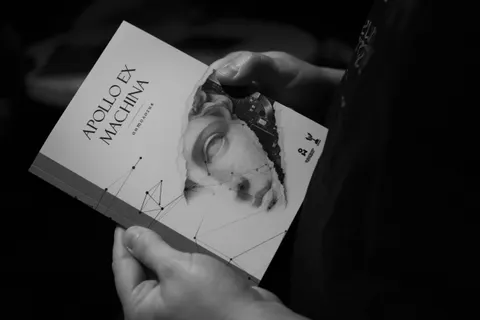
The time has come to announce the winners of Apollo ex Machina, Bulgaria's first (and one of the world's first) competition for poetry created with the help of artificial intelligence. The jury's picks were revealed at a ceremony in the Sofia City Library, where the anthology of selected entries, published by Scribens, was also presented. In a moment you can read the best poems and judge for yourself how good they are.
 23
Go: The Great Game
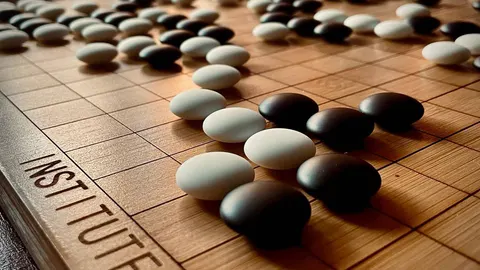
Two people stare stubbornly at rows of neatly arranged, round, flat stones. Just a game, you might say, but it is not that simple—not at all. This is not only one of the oldest games we know but also the most complex, and for a long time we considered it humanity’s last bastion, the place where technology could never overtake us. When it finally did, a remarkable new digital story was born.
 24
What Do Bulgarians Think About AI Today?
What do you think about artificial intelligence? Is it a danger or an opportunity? The future or the present? Marketing or a colossal breakthrough? In December I invited anyone willing to fill out a short but important survey, the same questions I asked a year and a half ago. Nearly 350 people took part this time, and now it is time to compare the two rounds, look for trends and sketch together today's landscape of how Bulgarians feel about the most discussed, most dizzying technology of our time.
 25
How Henry Kissinger Foresaw the Future
“There are two ways to make sense of the present situation. The first is by projecting from the familiar. Until now, the most transformative technologies created by humanity have served to refine or amplify our bodily capabilities. (…) Is AI simply one more extension of human capabilities? The second way of making sense of it assumes that this time the situation is different—that AI possesses unique qualities that cannot be reduced to an upgrade of human abilities. Within a few decades, through engineering, an analogue will be created of what evolution has been building over millennia—namely the human brain: the last organ left to be reproduced or reimagined inorganically.” We are not simply living in dynamic times in which we humans fail to keep up with technological progress. We have reached a moment when technology itself is making us start over. We have to redefine many of the concepts and systems that make up our lives—from democracy and capitalism to art and creativity. That's not me telling you this, but good old Henry Kissinger, who, on top of everything, is sending his messages about the future and artificial intelligence… from the beyond. The final work of one of the defining figures of the 20th century has recently come out in Bulgarian—the work of the man to whom we largely owe the fact that the Cold War stayed cold instead of turning into World War III. Genesis: Artificial Intelligence, Hope, and the Human Spirit gathers Kissinger's crucial views on the future we are already living in. Here are 14 of its highlights; may they finally spark the overdue public conversation about the future of humanity in the age of advanced technology and artificial intelligence.
 26
AI: Revolution or Marketing Hype? Your Opinion Matters! (Survey)
Is artificial intelligence unjustified media hype or the great force that will change our future as a species? Will it open incredible opportunities for people, or turn the world into a digital concentration camp? Your opinion is extremely important, and I will be grateful from the bottom of my heart if you share it in a short survey! Prizes await too: selected books! Responses are collected until December 31. You can choose which questions to answer. The survey is anonymous. Every response, every share is invaluable help in seeing how we relate today to the great technological subject of our time!
 27
“If It’s Beautiful, Does It Matter That AI Wrote It?”
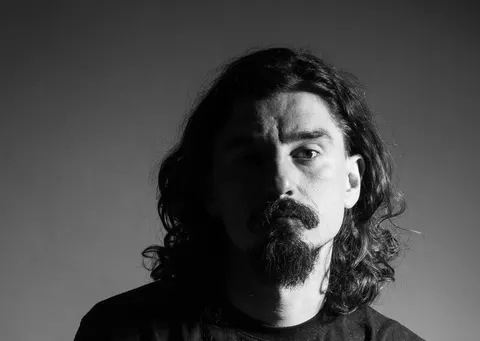
Is there room for poetry in the age of TikTok and artificial intelligence? How do we return this art to the pedestal it deserves? Can today’s poets be influencers, and should they? Is the time when artificial intelligence can no longer be separated from poetry frightening, or a dream come true? Apollo ex machina is the name of Bulgaria’s first competition for poetry created with the help of artificial intelligence, and now is the moment to join in! The venture’s special name was coined by today’s guest. Besides sitting on the competition jury, he runs the publishing house Scribens, which will publish the best poems from it in a collection. Georgi Gavrilov is a poet and… a physicist. He founded Scribens to give young Bulgarian authors a chance to reach their readers.
 28
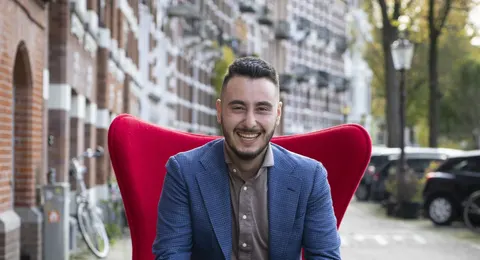
“Engineers Will Always Be in Demand. But Our Skills Have to Change”
Work in the software world has already changed fundamentally with the arrival of artificial intelligence. On November 29, at the conf.ai workshop, Djemal Ahmedov will harness AI agents and make them work as an entire software team. Before that, we talk about the chaotic present and uncertain future of software in the age of advanced AI, and about whether there will always be a human in the loop.
 29
“No, Now Is Not the Time for Poetry!”
What is poetry written with the help of artificial intelligence? Does AI write it alone, does it depend on the task the human sets, or can the two find a way to create something different together?
 30
Apollo ex machina: Enter Our Contest for AI-Generated Poetry!
Enter Apollo ex machina, the first Bulgarian contest for generated poetry, organized by Digital Stories and Scribens Publishing! There are no limits on theme or length. The only requirement is that you submit verse you have created with the help of AI. You may send up to 3 works, and the deadline is December 1, 2025. The winner will receive a prize of 300 leva (about $175), selected books await the well-deserved second and third places, and the best poems will be published by Scribens in a poetry collection! They will be chosen by a distinguished jury: the poets Petar Chuhov, Boyko Lambovski and Violeta Kuneva, Scribens managing director Georgi Gavrilov, and the creator of Digital Stories, Georgi Karamanev.
 31
What Kind of “Person” Is AI? A Psychological Experiment
We invite four of the most popular AI models into the psychologist’s office to find out what kind of “personalities” they turn out to have! Domineering or easily swayed, sensitive or pragmatic? What are GPT-5, Claude Opus 4.1, Gemini 2.5 Pro and o3 like by “character”?
 32
Living Your Imagination
You can hardly have missed this modern debate, and you probably have your own opinion on it: now that artificial intelligence produces results indistinguishable from human creativity, will we go on creating? Is the great hero of our day taking over the human role of author, or is it just another link in history's long chain, the new tool that will give birth to the next arts, genres and forms? Welcome to the world of David Szauder. For the Hungarian multimedia artist, reality is only a starting point—life unfolds in the boundless space of the imagination, where technology is the artist's new brush and the absurd and the beautiful meet and complete each other.
 33
The EdAItor Test: Can Artificial Intelligence Edit a Text?
While we debate whether artificial intelligence will ever write indistinguishably from a human (and it already can!), everything quietly changed. Whether we realize it or not, we now read algorithm-generated texts every day. The latest undeniable proof surfaced on social media a month ago: some of the most respected Bulgarian media outlets uncritically published texts riddled with the telltale sentences that unmistakably show they were written by ChatGPT or its kin, and that were not even read by their “author” before going online. So can't we invite AI to save us… as an editor? Not long ago we tested how some of the most advanced AI models perform as proofreaders, and now it is time to raise the bar. In our next major experiment, we put AI's skills as an editor to the test.
 34
“We Can No Longer Think Only About Endless Growth!”
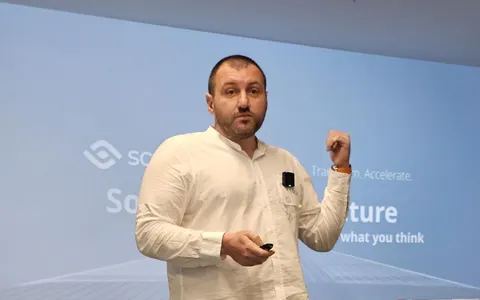
“Right now we don't have the conditions for AI to develop dramatically,” says Krasimir Kostadinov, chief technology officer of Scalefocus, who argues that the future of IT has aspects even more important than artificial intelligence. After his provocative talk at the 9th DEV.BG All in One conference, we continued the conversation about the Bulgarian dimensions of the IT future. Is it worth entering IT in Bulgaria today, and which qualities matter in the dynamic times we live in?
 35
Can We Tell a Generated Voice from a Human One? The Answer Is Clear
Can you tell a human voice from one generated by algorithms? 2,036 people took part in the Digital Stories experiment looking for the answer to this question, along with many other important nuances. The result, in my view, is unambiguous…
 36
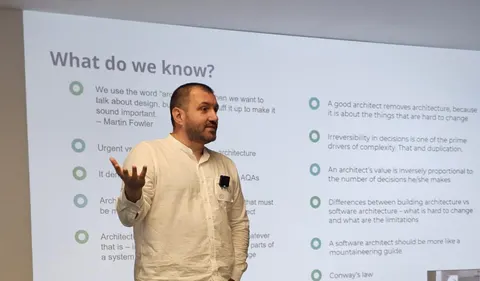
“Right Now, the Conditions Simply Aren't There for AI to Make a Dramatic Leap”
With Krasimir Kostadinov you can talk about geopolitics, astrophysics and history, all in the context of technology, the march of time and the trends that shape all our lives. He is the chief technology officer of Scalefocus: an engineer, architect and programmer with wide-ranging interests and deep knowledge, which he often shows off in his tech blog. In his current role, one of his direct duties is… to peer into the future, trying thoughtfully, sensibly and from every angle to predict where technology is taking us. We will peer into the future with him, for a sober and very different look at AI and the other big themes of the new age. Join us for a stroll through what lies ahead!
 37
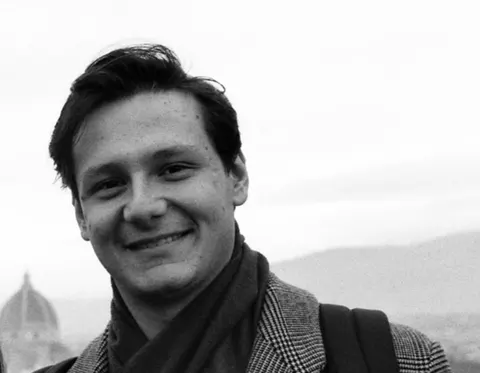
“Kids Today Are Still Curious!”
If anyone can compare how the knowledge of Bulgarian language and literature is developing, both in high school graduates and in AI, it is today’s guest. For the second year running, Mr. Svetoslav Stoychev took part in the Digital Stories experiment that tested how the newest AI models handle the national school-leaving exam, and this time he helped bring in two real graduates. Now we talk about the results, about students’ love of books, and about what keeps a young teacher burning for the profession in the age of artificial intelligence.
 38
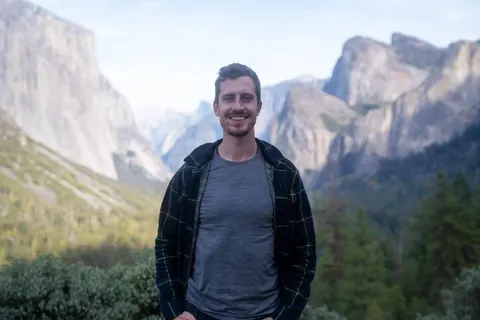
“I Don't See Programmers Disappearing”
Minko Gechev holds a black belt in karate… and, as a seasoned senior developer at Google, in programming too. Last time we followed his fascinating path from the small Bulgarian town of Troyan to one of the software giants of our time; now we turn to some of the most exciting questions of the day: what the future of software engineering looks like from its Mecca, Silicon Valley, whether the programmer's profession will survive at all, what is worth learning today and whether we can prepare for an exciting but challenging future. And how does our guest rediscover the wisdom of the East at the very heart of Western technology?
 39
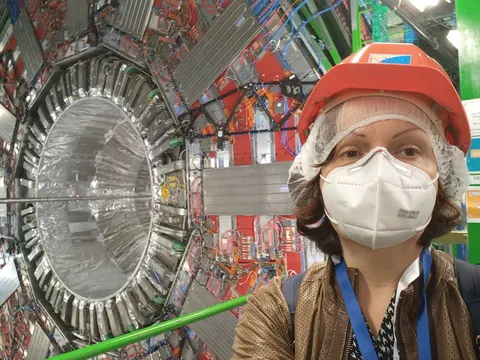
“AI Is Everyone’s Big Chance to Climb Their Own Everest”
“The world stands at the Rubicon. We will live alongside smart machines, a new and different world awaits us, but are we ready for it?” That question, the very reason Digital Stories exists, is posed on the cover of her new book by today’s guest, Petya Minkova. In The Transition from the Digital Age to the Hybrid Civilization, she traces the long road from the first computers to a future of superpowerful artificial intelligence. And while the answer to whether we are ready is clear, there are so many other important questions we will discuss in the lines below! Do we have any future other than as a hybrid civilization of humans and technology? What does our survival depend on, and what will our daily lives look like once this transition hits with full force? Why is AI far more than a danger—why is it also a chance for each of us to climb our own personal Everest?
 40
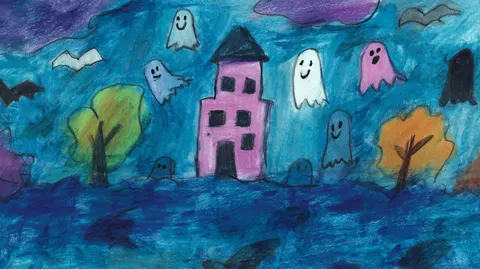
Child or AI? Could 4,000 People Tell Who Drew It?
The “Child’s Drawing or AI?” experiment drew enormous interest! In a month and a half, almost 4,000 people took the quiz, trying to tell 15 real drawings by children under 11 from images created by artificial intelligence. Time to sum up the results: did we rise to the challenge, were the real or the generated drawings easier to spot, did the children themselves judge better, and why do the conclusions matter?